Friday, July 28, 2006

Polish Art Collections in Michigan, from Poles in Michigan

Excerpt from: Poles in Michigan Vol. 1 Detroit, Mich. 1953.

Polish Art Collections in Michigan by Stanislaw Janicki

The tragic history of the Polish nation reflects itself not only in literature, painting and music but also in various collections of remembrances and works of art which were treasured by Polish generations as precious relics. Polish museums, libraries and private art collections have thus their special history.

In almost every Polish museum there are some relics of national martyrs and heroes of the Polish insurrections, like rosaries from bread, prison chains, or signs with an inscription, “Speaking Polish is prohibited”. Such signs were hung in the Polish towns during the czarist rule in Poland.

The last war brought new exhibits and new remembrances from German concentration camps in Dachau, Oswiencim and Birkenau, such as lampshades and book covers made from skins of the tortured and cremated.

The Polish political emigrants have in their possessions items as such as vestments made secretly by the people, of old blankets for the priests saying Masses in Siberia, pictures of thin, emaciated children and descriptions of experiences and tortures in the Russian prisons.

During the past centuries, Poland was systematically robbed of art works and valuable relics. Toward the end of the 18th century, during and after the fall of the Polish Republic, plunder of Polish art was methodically carried on by all partitioning powers. At that time, the royal insignia from Wawel secretly disappeared. This insignia was stolen on orders from the Prussian King, Frederick Wilhelm II and melted into war equipment.

One of the biggest and the most valuable libraries, the Zaluski Library in Warsaw, containing over 320,000 priceless books, was plundered by General Suvorov in 1795. Its contents were taken to St. Petersburg where it became the foundation of the famous Rus­sian Imperial Library. After both the insurrections of 1830 and 1863 the Russian museums and libraries were enriched with Polish works of art.

The 20th Century brought further devastation of Polish art exhibits and monuments. The Russian Revolution of 1917 destroyed famous palaces and manors in the former eastern part of Poland. Many famous original paintings of Canova, Rodin and others perished during revolutionary turmoil.

Between 1939 and 1945 there was mass destruction of Polish libraries and archives. These were purposely burned to obliterate Poland’s cultural tradition. Some catalogs, enumerating the magni­tude of destruction by the Hitlerites, were published in Poland after 1950. There is no accurate record of the plundering done by the Soviets who had stolen not only the art work, but also floors from some of the Polish palaces. Happily, the priceless Gobelin tapestry of King Zigismund August who reigned during the 16th Century, the coronation sword of the kings of Poland and other national treasures were saved and deposited in a Catholic monastery in Ca­nada. The story of this famous rescue was recently described by Alexander Janta. There are, however, some who would be willing to give these national treasures to the Soviets, in order to appease them.

During the partitions of Poland, political emigrants estab­lished the famous Rapersville collections in Switzerland. At the pre­sent time the Polonia in the United States has assumed the re­sponsibility of rescuing, gathering and preserving Polish national art and relics.

Year after year many strayed art items, old books and national relics find their way to the United States. They are bought and saved from destruction by both private individuals and by organi­zations. In 1952 the Central Citizens Committee of Detroit bought the thirty-seven (37) volume work, the famous “Polish Biblio­graphy” of the Professors Estreichers, and presented it to the Detroit Public Library. This bibliography describes all Polish publications from 1470 to 1900.

In the Detroit Institute of Arts there are a few Polish exhibits. These are the “Wounded Stag” by Elie Nadelman - Poland 1885, purchased in 1919, and the desk belonging to Queen Maria Lesz­czynska, wife of King Louis XIV. The friends of Polish art donated to the Detroit Institute of Arts a tapestry, “Hocul Dance”, by Eleanor Plutynska, a miniature of Chopin by Sowy Sowinski, min­iature portraits (of unknown origin), depicting Stanislaus Ponia­towski, the father and Andrew Poniatowski, the brother of the last Polish King, as well as a royal chalice which belonged either to King August II or his son, King August III. While the painters the above mentioned miniatures are unknown, it is believed they were painted by either Karol Bechon, Violant, Vincent Lesseur, or Anthony Kucharski, as all of these artists painted for the last Polish King.

To Be Continued Next Friday...

Poles in Michigan, Vol. 1

I bought a book yesterday. It's an older book that I bought from an online used book seller. The book is titled: Poles in Michigan Vol. 1 Detroit, Mich. 1953. It's a paperback book, 120 pgs. The inside cover says,
Poles in Michigan, A book devoted to the study of the Polish group in Michigan.

Publishers: "The Poles in Michigan Association" 3061 Penobscot Building, Detroit 26, Michigan.

Editorial Committee: Benjamin C. Stanczyk, Eugene Konstantynowicz (W.J.L.B.), Anthony Rathnaw, Stefan L. Wloszczewski, Eugene Brominski, Anthony Wojsowski.

Published - January 1955.
The back cover says,
Cover and Vignettes
Designed by Anatol Girs
Lithographed by
High Point Offset Corporation, Detroit
Printed by the Glow Press
Detroit
I believe this book was essentially "self published" by this group who probably had the intention of writing/publishing additional volumes. To date, I have not been able to locate any additional volumes so I don't know if there actually were any or not.

I bought the book hoping to find information about notable people among Detroit's Polonia and I wasn't disappointed. It's full of information about the local Polish community as well as information about famous Poles who had ties to Michigan/Detroit.

Here's the Table of Contents:
  1. Introduction
  2. Kazimierz Pulaski-Hero of Two Worlds - Stanislaw Janicki
  3. Polonia, and It's American Contribution - S.B. Stefan
  4. The Polish Pioneers on the North American Continent - S.B. Stefan
  5. The Trail of hte Polish Emigrants in Michigan - Dr. Stefan Wloszczewski
  6. Michigan's Foremost Polish Priest - Rev. Joseph Swastek
  7. Posen-The history of an old Polish Settlement in Northern Michigan - Dr. Stefan Wloszczewski
  8. First Polish Settlers in Detroit - Dr. Ludwik Gozdawa
  9. The Origin and Growth of the First Polish Parish in Detroit - Dr. Ludwik Gozdawa
  10. The Rise and Growth of the Polish National Alliance in Detroit - Benjamin Stanczyk
  11. Father Dabrowski-The Polish Seminary - Rev. Joseph Swastek
  12. The Oldest Polish Village in Michigan - Rev. Joseph Swastek
  13. The Educational Work of the Felician Sisters in Michigan - Sister Mary Jeremiah C.S.S.F.
  14. History of the Polish Press in Detroit - R. Jazabkowska
  15. Central Citizen's Committee - Clara Swieczkowski
  16. Polish Merchants in Michigan - A. Wojsowski
  17. Polish Art Collections in Michigan - Stanislaw Janicki
  18. H. Sienkiewicz in Detroit - W. Witkowski
  19. Henryk Sienkiewicz-World Famous Author - Dr. Arthur P. Coleman
  20. The Significance of Polish Literature in America - Edmund Ordon
  21. Polish Studies at Wayne University - Edmund Ordon
  22. A Selection of Polish Literature in English Translation.
In addition to loads of surnames (which genealogists just love to peruse) and the text for the articles listed in the TOC, the book also has three photographs. I am going to post excerpts from this book in my blog each Friday, starting today.


Thursday, July 27, 2006

GenMates, Social Networking Site for Genealogists

Here's a new web site that's essentially an online social network for genealogists. Want new friends who share your passion for genealogy? This is the place! www.GenMates.com .

Genealogists Now have Their Own MySpace Alternative:
Manchester, UK (PRWEB) July 27, 2006 -- July 2006 sees the launch of GenMates, which is a social networking site for genealogists and those interested in family, garden and home areas.

"With the launch of GenMates they can:


*Write a blog and publicise their genealogy research with their unique blog link

*Create their own groups or forums to bring people with common interests together. This includes being able to set up forums specifically for those researching the same names

*Promote events and obtain information on forthcoming events

*Get special discounts from our professional/business membe
rs
*Sell personal items to other users
and much, much more......

Paul Duxbury, the co-founder of GenMates, commented recently that “Some genealogists have referred to GenMates as the Genealogy MySpace Alternative because of the fantastic range of services we provide and, best of all, they are all free to ordinary members!”


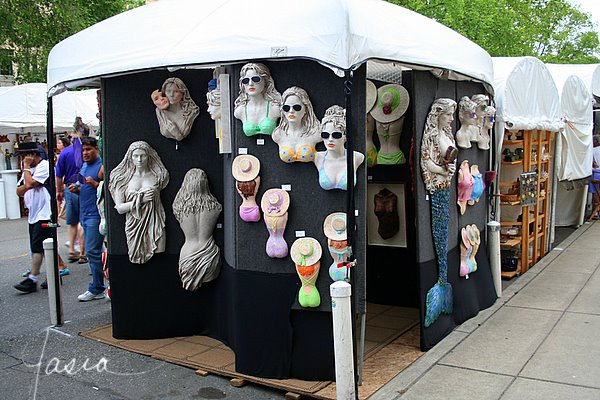
Interesting critters, Ann Arbor Art Fair

Tuesday, July 25, 2006

Let's Hear It For The Ladies!

It seems like such a little thing, really. The idea of including women on a family tree. After all, we know they had to be there helping to create the family in the first place, contributed their share of DNA... couldn't make a family without them. So who would create a family tree without women?

Evidently the Chinese would. I guess women are pretty insignificant in their scheme of things, at least in Confucius' family tree they are:

People's Daily Online -- Female descendants included in Confucius family tree for the first time:
"In China, where men have traditionally been regarded as superior to women, and in a family in which tradition is strictly observed, it is of great significance that female descendants of Confucius will now be included in the family tree," said Liu Shifan, Vice President of the International Confucius Association.
I'm certainly no expert on Confucius. All I really know about him was that he was a significant Chinese philosopher. Over the years I've heard "Confucius say..." a hundred times in a hundred different situations (some of them humorous) and I thought that this must have been one wise dude. I'm rethinking my assessment after reading this article.
Confucius was a great philosopher and teacher. He founded Confucianism in ancient China, and the thoughts and doctrine of Confucius have had an enormous influence on China's people and history for many generations. Confucius advocated an optimistic attitude, attention to moral code and historic experiences, but he also believed in speaking out and he considered men to be superior to women.
Notice that it doesn't say that he thought women had no place in a man's world. They're currently compiling his genealogy for the 5th time... and taking years to do it I might add. The last time it was compiled was in 1937. So I guess ole Confucius and his superior male descendents have been condescending to spend some t
ime with lowly women over the years.

Since Confucius believed in speaking out, he'd no doubt appreciate my choosing to make a public statement on the matter. Then again he might discount it because I'm a woman. But what the heck, I'm gonna say my piece anyway. That's my tradition! I say it's about time his genealogy compilers broke with tradition and quit doing something just because its always been done that way. Now if we could just get the Catholic Church to reconsider some of it's traditions regarding women... and the Good Old Boys network down south... and definitely the Taliban in Afghanistan... and then there's... well, you get my drift.

I applaud Confucius' genealogy compilers! Let's see those women's names on the family tree!!!


State Street Art Fair, Ann Arbor, MI

Sunday, July 23, 2006

Balloon Race, The Michigan Challenge


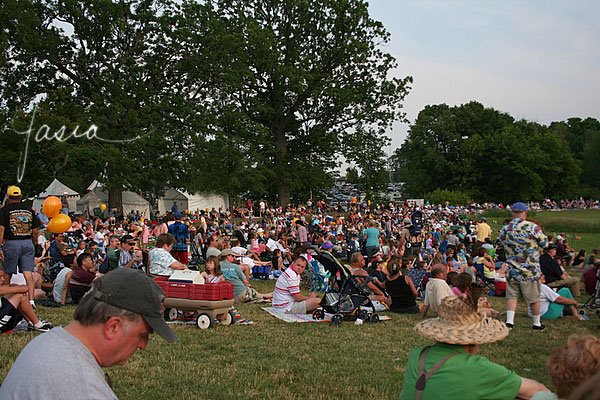
The crowd waits impatiently on a hot summer evening in Howell, Michigan. It's the weekend of the Michigan Challenge, Hot Air Balloon Festival.

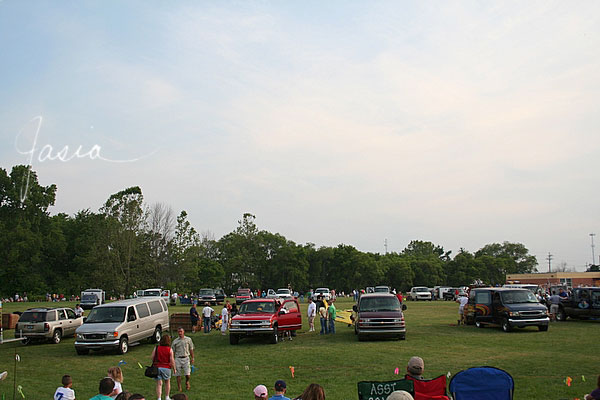
As the evening approaches, the competitors assemble on the field. The balloons only fly during the first 2 hours after sunrise and the last 2 hours before sunset. This particular weekend, the weather conditions were great. They got 5/5 launches in (Fri. evening, Sat. morning and evening and Sun. morning and evening).

Eventually, one of the crews starts to inflate their balloon. The crowd noise increases as people's excitement builds. There's anticipation in the air...

In just a few minutes the first balloon is inflated and on its way. The crowd cheers loudly as the basket lifts off the ground. This first balloon will set the target in a game called "Fox and Hounds". Its given a few minutes head start and then the other competitors will chase it and try to drop their marker on the target set by the first balloon captain.

The excitement builds as all of the other competitors race to get off the ground. It was my first time at a balloon launch and I expected each balloon to take off one at a time, like the first balloon did. But that was not the case! They all started at the same time. It's almost magical to watch the huge, colorful, graceful balloons take shape.

With the first balloon in the distance, those still on the ground work feverishly to get themselves airborne.

The kaleidoscope of colors is nothing short of spectacular!

The flames from the burners are loud and awesome to view. The element of danger is in the air. If the balloon were to catch on fire it would be nothing short of a disaster.

One after another the balloons fill with air and take to the skies. It's hard to take in all the visuals at once. So many balloons, so much excitement... the crowd cheers with each new balloon launch. It often looks like they'll bump into each other, and sometimes they do. But they just continue to launch!

This was my favorite balloon. I just love the rainbow of colors!

It's quite a sight to take in... in all, 53 balloons participated in the Michigan Challenge this year.

In just a few minutes the majority of balloons are off and on their way. The last few scramble to get themselves up, up, and away!

The last balloon took flight and with it's rise the crowd was on its feet. As the roaring applause died down so did the excitement. It was almost as if the crowd's enthusiasm deflated instantly. It was a lovely event, more exciting than I would have guessed it would be.

Author James C. Martin's New Web Site

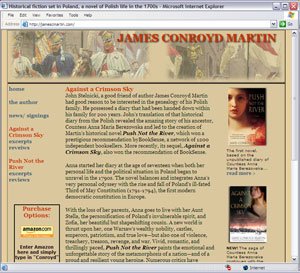
I've been busy. In case you haven't noticed, I haven't written any posts for my blog in a few days. I've been hard at work on another new web site that will be especially appreciated by those of you with Polish backgrounds. It's the new web site for author James Conroyd Martin. Many of you will recognize the name if you've read his first novel, Push Not the River.

Push Not the River was published by St. Martin's Press in 2004 and immediately won the hearts of critics and readers alike. Hailed as Poland's version of "Gone With the Wind", it captures an era of Poland's history when gale force winds of change blew across that country. The novel is based on the actual diary of Countess Anna Maria Berezowska and not only gives wonderful insight into the politics of the time but the emotions of the people as well. It's a wonderful story, one you'll want for your personal library if you don't already have it.


Next month, James Martin's next novel will be released (officially goes on sale
August 8 th). It's called Against a Crimson Sky and it's a sequel to Push Not the River. I'm in the process of reading an advanced copy right now and I'm enjoying it thoroughly. I'll write a review of it later this week. The new web site has an excerpt you can read right now and also a list of dates and places where Jim will have book signings next month. There's still plenty of time for summer reading so be sure and add Against a Crimson Sky to your reading list!