As I was sitting in my office this morning, paying my monthly bills online, I realized it was time to renew my genealogical society membership. I figured while I was at it, I might as well renew my membership with another gen-so that I had let lapse too. I pulled out my checkbook, wishing I could make an online payment along with the rest of my bills, when my thoughts drifted back to Denise's commentary on the article written by Jim, and to the comment I left on Denise's article.
The gist of it all is that Jim is lamenting the fact that membership in genealogical societies has dropped and he's hoping that the new Internet researchers will realize what they are missing and join genealogical societies in large numbers once again (his "Big Bang Theory). Denise then wrote about how she's had a "much more satisfying experience online" than she ever did at her local gen-so. I agree with Denise, as my comment reflects.
So then I looked down at my renewal membership form and asked myself what I'll get out of my membership. I'm really struggling with that. I rarely go to local meetings because the topics presented are geared towards beginners, which is a waste of time for me. I don't go to the conferences of the national organization because it's just never been feasible for me to travel to them. I do visit their web sites, but so does everyone else. They either don't have a special "members only" section or what they have there doesn't interest me. That leaves their journals, the ones I had to dust off and move recently when I got new office furniture. I quickly flipped through a couple of them and wondered if I should even bother keeping them. Trying to look up a topic, surname, or area of interest, in 8+ years of journals from two different organizations that overlap heavily on their content (Polish genealogy) would be a nightmare.
I thought about just not bothering to send in my dues since they don't provide me with information I can use in a way I can use it. But what kind of message does that send to the organizations? Would they understand that I believe in and value what they are doing and providing to their membership but not their methodology? I know from past experience as a board member of a gen-so that the folks who do not have or want to use computers/internet are quick and loud to complain, insisting that things continue to be done the traditional way. But does anyone else give their board members feedback about wanting them to march forward with more efficient ways of doing things? Have you ever written the gen-so board you belong to to tell them that it would be ever so nice if all of their past journals were searchable online? Or have you ever spoken with a board member to express how much you would value webcasts of meetings? I mean, think about it. If the only voices they are hearing are the ones who say, "don't change", is it any wonder that they are so slow to move forward and make changes?
I'm thinking it's time to start a campaign. A write-in campaign. What do you think about sending a letter in with your dues the next time your gen-so membership is up for renewal? Do you find your gen-sos lacking like I do? Would you be willing to let the leaders of the gen-sos you belong to know that you are not satisfied with the status quo and specifically identify what direction they should take to keep you as a satisfied member? (Assuming that you are dissatisfied like I am.) Food for thought.
By the way, I've decided not to discard my old issues yet. I'm going to scan them so they are searchable :-)
Showing posts with label Declining Membership in Genealogical Societies. Show all posts
Showing posts with label Declining Membership in Genealogical Societies. Show all posts
Wednesday, January 23, 2008
Thursday, November 29, 2007
Announcing A New Blog
 I received the nicest e-mail last evening. It was an e-mail I've been hoping to receive for over a year now. This e-mail was announcing the birth of a new blog. Not just any blog, but a genealogical society blog! So why am I so excited about this? Because this is the first blog I'm aware of that came about as a result of the series of articles that I wrote in August of 2006 on the declining membership in genealogical societies. It is truly gratifying to know that my series inspired someone to champion the cause and take the steps necessary to move their genealogical society into the 21st century.
I'm smiling from ear to ear :-D
In the scheme of things, this is just one small step for this genealogical society. But it's a step in the right direction. I applaud the Board of Directors who had the courage to support this idea and the individual who has taken on the task of authoring the blog. I'm sure she won't mind my telling you about her and her blog since in her first blog post she referred to me and mine.
Ladies and gentlemen, how about a round of applause for Kathryn at the California Genealogical Society and Library! Her new blog can be found at: http://calgensoc.blogspot.com/
Congratulations on your new blog Kathryn!


Tuesday, August 21, 2007
The Jasia and Schelly Show via DearMYRTLE
 For those of you who enjoy listening to podcasts, Schelly Talalay Dardashti, author of Tracing the Tribe blog, and I were guests of DearMYRTLE on her podcast posted today. You can listen to or download the podcast from DearMYRTLE's site. Our portion of the podcast begins about 37:30 into the program. Schelly and I discuss the use of the titles "genealogist" vs "family historian" and touch on other topics as well.
Myrtle is a very gracious hostess and Schelly is a very polished speaker. They both made me feel very comfortable about participating in this podcast. It's a lively discussion that I enjoyed very much. Schelly has a very engaging personality and Myrtle has so much share, I think the three of us could have gone on chatting for hours (but don't worry, we didn't)!
I want to say a special thank you to Myrtle and Schelly for giving me the opportunity to chat with them, promote our community of genea-bloggers, and the Carnival of Genealogy. It was fun!
Friday, June 08, 2007
Declining Membership in Genealogical Societies Revisited
I finally got around to reading the July issue of Family Tree Magazine, the one with the article where I'm quoted on the subject of declining membership in genealogical societies. Randy, Denise and Maven have already written very nice posts referencing it. Diane Haddad did a nice job with the article. She got my quotes right (that's always nice ;-) and didn't twist my meaning (that's always appreciated). After reading the article a time or two I tried to think of something new and insightful to add on the subject but nothing comes to mind.
At the end of the article Diane mentions that the topic is open for discussion on the Family Tree Magazine forum so I went to the site to check it out. Virtually every person who commented attributed the decline in memberships in gen. societies to the internet (and the plethora of information available on the web). I couldn't disagree with that. It's my thinking too.
George Morgan wrote an article this week (and Randy wrote a response) on how he spearheaded a major change in the Florida Genealogical Society, Inc. by analyzing the costs of traditionally publishing the society's publications, looking at alternatives, and finally choosing to move in the direction of electronic publishing. Yeah, George. Yeah, FGS. I'm glad to hear that some genealogical societies are changing with the times. Electronic publishing is one of the things I advocated last August when I wrote my series on the declining membership in genealogical societies so it's not a new idea to me. My thoughts run along lines of "It's about time, what's everybody else (other genealogical societies) waiting for?"
Dick Eastman wrote article this week explaining wikis, blogs, etc. It's not his first and probably won't be his last article on internet technology. God bless Dick. He just keeps delivering the message that this Web 2.0 stuff isn't new anymore and it isn't complicated either. Good for him. I'm glad he's doing it. He's got a large audience so maybe it will make an impact.
When I was the webmaster and on the board of directors of my local genealogical society 6 years ago I tried to find support for making the society more internet based but there wasn't much support to be had. Not enough to keep me on as webmaster and as a member of the board of directors. I believed strongly enough that the direction of the society needed to be internet focused (and including electronic publishing) that I was willing to resign from the board, resign as webmaster, and eventually dropout as a member of the society when it became evident that they were unwilling to make changes in the direction of progress. This didn't happen on impulse but rather over a period of years. I came to realize that we were not of like minds and never would be in regards to technology and change.
I was recently contacted and asked to quote on a web site re-do for a national genealogical society. I was happy to oblige and quoted them for a re-do using current Web 2.0 technologies. Their response was along the lines of, "We need to find out more to understand what this would do for us." It was a good response because there's a lot of money on the line (I may be a cheap drunk but I'm not a cheap web designer ;-) . But I'm finding it hard to get myself to make a pitch for the idea. It's like... I've been there, I've fought that battle, and I don't have the energy (or the passion) to fight that battle again. Maybe I'm just burned out. Maybe it wouldn't be much of a battle at all. Maybe I could make a nice presentation and they'd all jump on board. One can always hope.
So now it's been almost a year since I wrote my series of articles on the declining membership in genealogical societies, and what have I got to add? Not much. I applaud those who are still fighting the fight for change and those who are bravely moving ahead even when they're not sure what they're doing. Change is usually uncomfortable. It's also necessary.
For myself, I'm more interested in blogging these days than I am in being a catalyst for change in genealogical societies. I'm pleased to have been interviewed and quoted on the topic for a national magazine. Nuff said.
For myself, I'm more interested in blogging these days than I am in being a catalyst for change in genealogical societies. I'm pleased to have been interviewed and quoted on the topic for a national magazine. Nuff said.
My previous posts on the topic of declining membership in genealogical societies:
Declining Membership in Genealogical Societies: More Options For Making Your Society More Accessible
Sunday, August 27, 2006
Declining Membership in Genealogical Societies: On The Wiki
I've uploaded the entire series "Declining Membership in Genealogical Societies" to the Genealogy Wiki where it renders very nicely in both the Internet Explorer and Foxfire browsers. You can also print the articles in a more readable format there as well.
Technorati Tags:
Friday, August 25, 2006
Declining Membership in Genealogical Societies: Parting Advice
All good things must come to an end. And I want to believe that this series of posts has been a good thing. However, I don't claim that all the ideas presented in these posts are right for every group. Nor do I recommend that any genealogical society scrap every vestige of their existing group in favor of recreating a totally new group, at least not without the approval of their current membership. But certainly there are ideas here that could help just about any group be more appealing and accessible to their members and potential members.
It's apparent that I'm a strong proponent of utilizing whatever new or current technology makes sense to help people find their roots. In fact, the more the merrier. But I've been careful to suggest only those technologies that I believe ordinary people could set up for their societies. You don't need to be a web master to set up a social networking group, a blog, or a wiki. The internet has really become user friendly these days.
There is one recommendation that I would like make as I wrap up this series, and that is to check out what kinds of changes your current membership would appreciate most. First and foremost, you don't want to alienate your member base. Do not assume that you and your executive board know what's in the best interest of your group. You really should get feedback on what additions or changes your membership would like to see. If you're thinking about making changes but aren't sure if you'll get applause or complaints, ask your membership. A survey is a great way to do this.
Back when I was an active board member of my local genealogical society I created a survey that was mailed (postal mail) out to every member and it was also posted to the society's web site as a form so they had an option to complete it online or mail the form back (I controlled the online form so that people could not vote multiple times). It was a multi-page form that asked members to rank what the priorities for the society should be as well as making suggestions for future meeting and seminar topics, content for the web site, research topics to be addressed in the journal, ongoing group research projects, if we should have a newsletter, etc. The survey also asked if members had computers and/or internet access. This survey was done about 5 years ago when the group had in the neighborhood of 500 members.
We got over 100 completed surveys, certainly a good enough percentage to make the results carry some weight (and way more than the typical voter turnout for the election of officers each year). Some of the results were predictable. But what was a surprise to most of us was the high priority placed on the society's web site. It was second in importance only to the society's journal. And this was back before Broad Band was common and the vast majority of our members who had computers and internet access had a dialup connection to the internet. But you see, the journal and the web site were really the only things that benefited members who lived out of the area. And I suspect that if the society's journal were put online as a part of the web site (like posting articles to a wiki) it would have made the web site their top priority.
Without going into a lot of detail, an entire new slate of officers were elected a couple months after the results of the survey were compiled. The new administration "did not put much faith in numbers" and was committed to doing things the traditional way they had always been done. And to this day nothing's really changed in that respect. Membership is less than half what it once was and I doubt if any changes they could implement now would get those numbers back... short of offering membership for free. In all fairness, I have to say that the organization had other serious issues besides a resistence to change that led to its decline in membership. So I certainly don't want to paint the picture that doing things the traditional way is solely responsible for the substantial drop in membership. But I do truly believe that their determination to continue running the organization the way it has always been done has contributed greatly to the decline in their membership.
In reflecting back on the writing of this series, I have to admit that I had no idea I had so much to say on this subject when I started. I'd like to tell you that I thought this all out ahead of time but I didn't. Oh I did start with an outline but I certainly didn't envision a 14 part series when I began! And to be honest with you, the hardest part of writing it was trying to find concise ways to word things. I'm not a concise-style writer in case you haven't noticed ;-) I could easily have turned this into a book, and I'm not kidding. There are so many details and considerations that I had to omit in the interest of my blog readers. Each post could have been a chapter, and 14 chapters could have made a book. But I'm content with what I've written.
I strongly believe in the concept that genealogical societies were founded on... that a group of people working together, sharing with and educating each other benefits all the members more than if they were each working independently on their family history research. I really want to see genealogical societies continue and flourish. I hope in some small way I've contributed to that cause.
Let's get these ideas and suggestions circulating around the net. I'm sure I haven't thought of everything that could help stop the trend of declining memberships in genealogical societies. People like Lee Anders are wondering "What's in it for me?". If you've got a good reason why Lee should join a genealogical society, let's hear it. There's a comment link below.
Now, who wants to hire me as a consultant? ;-)
It's apparent that I'm a strong proponent of utilizing whatever new or current technology makes sense to help people find their roots. In fact, the more the merrier. But I've been careful to suggest only those technologies that I believe ordinary people could set up for their societies. You don't need to be a web master to set up a social networking group, a blog, or a wiki. The internet has really become user friendly these days.
There is one recommendation that I would like make as I wrap up this series, and that is to check out what kinds of changes your current membership would appreciate most. First and foremost, you don't want to alienate your member base. Do not assume that you and your executive board know what's in the best interest of your group. You really should get feedback on what additions or changes your membership would like to see. If you're thinking about making changes but aren't sure if you'll get applause or complaints, ask your membership. A survey is a great way to do this.
Back when I was an active board member of my local genealogical society I created a survey that was mailed (postal mail) out to every member and it was also posted to the society's web site as a form so they had an option to complete it online or mail the form back (I controlled the online form so that people could not vote multiple times). It was a multi-page form that asked members to rank what the priorities for the society should be as well as making suggestions for future meeting and seminar topics, content for the web site, research topics to be addressed in the journal, ongoing group research projects, if we should have a newsletter, etc. The survey also asked if members had computers and/or internet access. This survey was done about 5 years ago when the group had in the neighborhood of 500 members.
We got over 100 completed surveys, certainly a good enough percentage to make the results carry some weight (and way more than the typical voter turnout for the election of officers each year). Some of the results were predictable. But what was a surprise to most of us was the high priority placed on the society's web site. It was second in importance only to the society's journal. And this was back before Broad Band was common and the vast majority of our members who had computers and internet access had a dialup connection to the internet. But you see, the journal and the web site were really the only things that benefited members who lived out of the area. And I suspect that if the society's journal were put online as a part of the web site (like posting articles to a wiki) it would have made the web site their top priority.
Without going into a lot of detail, an entire new slate of officers were elected a couple months after the results of the survey were compiled. The new administration "did not put much faith in numbers" and was committed to doing things the traditional way they had always been done. And to this day nothing's really changed in that respect. Membership is less than half what it once was and I doubt if any changes they could implement now would get those numbers back... short of offering membership for free. In all fairness, I have to say that the organization had other serious issues besides a resistence to change that led to its decline in membership. So I certainly don't want to paint the picture that doing things the traditional way is solely responsible for the substantial drop in membership. But I do truly believe that their determination to continue running the organization the way it has always been done has contributed greatly to the decline in their membership.
In reflecting back on the writing of this series, I have to admit that I had no idea I had so much to say on this subject when I started. I'd like to tell you that I thought this all out ahead of time but I didn't. Oh I did start with an outline but I certainly didn't envision a 14 part series when I began! And to be honest with you, the hardest part of writing it was trying to find concise ways to word things. I'm not a concise-style writer in case you haven't noticed ;-) I could easily have turned this into a book, and I'm not kidding. There are so many details and considerations that I had to omit in the interest of my blog readers. Each post could have been a chapter, and 14 chapters could have made a book. But I'm content with what I've written.
I strongly believe in the concept that genealogical societies were founded on... that a group of people working together, sharing with and educating each other benefits all the members more than if they were each working independently on their family history research. I really want to see genealogical societies continue and flourish. I hope in some small way I've contributed to that cause.
Let's get these ideas and suggestions circulating around the net. I'm sure I haven't thought of everything that could help stop the trend of declining memberships in genealogical societies. People like Lee Anders are wondering "What's in it for me?". If you've got a good reason why Lee should join a genealogical society, let's hear it. There's a comment link below.
Now, who wants to hire me as a consultant? ;-)
Technorati Tags:
Declining Membership in Genealogical Societies: Two Plans for Marketing Your Group
Boy, I have a lot of ground to cover here because there's so much room for improvement in the way genealogical societies market themselves. Let's face it, most don't do any marketing at all. But there is so much competition out there for people's hobby time that you have to find a way to draw attention to your group (and entice people to join) or they won't stand out from the crowd. Let's try to keep this simple with two 3-step plans. The first plan will be for general things you can do to help with marketing your group. The second plan will be specific to marketing on the internet.
3-Step Plan for Marketing Your Genealogical Society
There is no substitute for a professional image. Having a professional image makes your group look more organized, more substantial, and more serious. So make the "face" that you show the public as professional as possible. And then "show your face"!
1. Start with a professionally designed logo. If you don't have someone in your organization that is trained to do this than you need to find someone who is. There is no substitute for someone trained in graphic design when it comes to creating a logo. Now this doesn't have to cost a lot of money. If there's no one in your group who can do it, make a call or stop by your local community college or high school. Ask to speak to the department head of the art/graphic design program. Tell them you need a new logo for your not-for-profit group. Most instructors and program directors love having real-life projects for their students to tackle. They could even turn it into a competition among the students. You could offer the winner a $25-$50 gift certificate at Best Buy, Amazon.com or wherever, and you've just bought yourself the best value money can buy for a well designed logo.
I participated in one such competition as a student (I won too!). The logo happened to be for a new restaurant but that really doesn't make any difference. I can tell you that the competition was great fun. There were a lot of great logos to choose from and it was a win-win situation for everyone.
You could take it a step further and invite your local media to the final judging. Not only does the winner get his/her name in the media (which all struggling designers need to do to establish a reputation for themselves), but your organization is getting free press coverage as well.
2. Get a professional publicist to write up some pitches (pay them if you have to!) that have a cross gender, cross generational appeal. Think fresh! It doesn't have to be a big budget item and it doesn't have to be done on an ongoing basis. If there isn't anyone with PR or advertising experience within your organization, consider another trip to your local community college or high school. What you're looking for is a byline or tag line to use along with your logo. You'll put it on your group's stationary, business cards, web site, etc. PR professionals are trained to put a positive spin on things. They're all about promotion. They can help you come up with catchy slogans to grab people's interest. Some communities have business retirees who volunteer to do some consulting for small business owners. This is another source you can tap for help with advertising/PR.
3. Print up business cards that have your logo, slogan, group's name, web site address, and meeting dates/times/places if the group meets regularly. Have a batch of business cards printed up. Business cards don't cost much to print. You can order them online in large quantities if need be. What you're then going to do is give a dozen or so to every member in your group. Include them in initial membership or renewal packets or pass them out at meetings with the instruction to "become an ambassador for the organization".
Members should be encouraged to pass out these cards to anyone they have a casual conversation with when they're at the library doing genealogy research, chatting with someone at the bus stop, or even leave one with a tip for their favorite waitress. The point is to use these cards like a mini brochure for the organization. Ask group members to talk up the group whenever they get the chance... and pass out those business cards! Leaving brochures around the library is fine, but leaving a marketing piece with someone after a personal conversation inviting them to visit the group will have much more impact. Remember, genealogy is a people-based hobby if ever there was one. Word of mouth advertising by your members is a very personal and powerful resource. Use it!
3-Step Plan for Marketing Your Genealogical Society on the Internet
You must use smart marketing for your group, especially in terms of the internet. While it's important to have valuable content on the organization's web site so that people will visit and make return visits, you don't want to give it all away to the public or there's no incentive for them to become members. I am a big promoter of making content information available and accessible on the internet. But, you should carefully select a feature(s) or venues that are for the exclusive use of members only. It will become an enticement for visitors to join the group.
1. Have a "member's only" section of the website and give them access to information that the public doesn't have access to. You're already doing that with the society's journal. The society's meetings may be open to the public but everyone who attends a meeting doesn't get a copy of the latest journal. Only dues paying members get the journal. Treat the society's web site the same way. A very simple way to do this is to start a Yahoo Group. For those who aren't familiar with the concept of a Yahoo Group see my previous post. In this case, the idea would be to make the Yahoo Group private to dues paying members only. When members register with the society they would need to give an email address and then the Yahoo Group's moderator (appointed by the society) would "invite" them to join the group and in this way control who gets access and who doesn't. Once they login to the Yahoo Group they would have access to group member messages, databases, photos, polls, files, links and calendars. The society could upload selected files, databases, photos etc. here for member access only. This would have to be strategically planned content that members would find of value, not simply a collection of past newsletters. Offer some information they can't easily access elsewhere and you've just given them a reason to join your society. You'll also need to describe this "member's only" content on the society's web site so that people who visit the site will learn about it. Just be careful not to over do it and put too much of your content into the "members only" section. If you do that you'll start to see a drop in the traffic to your web site. There are some people out there who are only interested in free and you don't want them to stop coming to your site. The amount of traffic to your web site is one element in the algorithm that search engines use to determine rankings. And you want your society's web site to be highly ranked.
2. You also should have a plan to market your organization on the internet. There is an entire industry built around search engine marketing, that's how important it is. It's not enough to just get your organization's web site listed with a major search engine or two. You need to go beyond a mere listing to one that gets people to actually click on the link to your society's web site. There's a craft to that. If I type the words "Polish vital records" into Google, I get 1,510,000 results. And that's just today. Tomorrow there's likely to be even more (because the internet is always growing ;-). But searchers will rarely look past 3 pages of search results. That's the industry average. So you need to get your organization's site listed in those first few pages to drive potential members to your web site. And your organization's site needs to be well listed for a variety of search terms, because "vital records Poland" will get you an entirely different set of results (2,040,000 of them, today, in Google, to be exact), than did "Polish vital records". And if you have good information about finding vital records in Poland on your organization's web site you need to make sure it's submitted properly to the major search engines so that your site comes up in the first few pages for all relevant search terms. And you need to make sure that the information that comes up when the listing appears in Google's search results is current. At some point I'll write a separate blog post on the dos and don'ts of search engine marketing. But for now what your web master needs to know is that search engines like Google, Yahoo, and all the others, index your site based on text. So they better have text on your society's home page and that text better include key search terms that people are likely to use when looking for the information you have on your site.
3. Probably the most important thing you can do to promote your society and its web site is to frequently add new content to the site. The more often the better. People will visit more if they find some new content when they do. That may mean that you'll have to reassess the time/talents of the volunteer members and their roles in the society. You may need to have more people writing for a blog than the printed journal. Or you may need to invite guests to write a blog post. Of course Blogs aren't the only answer, but they are probably the quickest and easiest way to add fresh content to a web site on a regular basis.
So we've covered two 3-step plans for marketing your genealogical society. They aren't all-encompassing plans but hey, if your group doesn't have a marketing plan now it's a good place to start. Next I'll post some of my thoughts on writing this series of articles and give a last little bit of advice.
3-Step Plan for Marketing Your Genealogical Society
There is no substitute for a professional image. Having a professional image makes your group look more organized, more substantial, and more serious. So make the "face" that you show the public as professional as possible. And then "show your face"!
1. Start with a professionally designed logo. If you don't have someone in your organization that is trained to do this than you need to find someone who is. There is no substitute for someone trained in graphic design when it comes to creating a logo. Now this doesn't have to cost a lot of money. If there's no one in your group who can do it, make a call or stop by your local community college or high school. Ask to speak to the department head of the art/graphic design program. Tell them you need a new logo for your not-for-profit group. Most instructors and program directors love having real-life projects for their students to tackle. They could even turn it into a competition among the students. You could offer the winner a $25-$50 gift certificate at Best Buy, Amazon.com or wherever, and you've just bought yourself the best value money can buy for a well designed logo.
I participated in one such competition as a student (I won too!). The logo happened to be for a new restaurant but that really doesn't make any difference. I can tell you that the competition was great fun. There were a lot of great logos to choose from and it was a win-win situation for everyone.
You could take it a step further and invite your local media to the final judging. Not only does the winner get his/her name in the media (which all struggling designers need to do to establish a reputation for themselves), but your organization is getting free press coverage as well.
2. Get a professional publicist to write up some pitches (pay them if you have to!) that have a cross gender, cross generational appeal. Think fresh! It doesn't have to be a big budget item and it doesn't have to be done on an ongoing basis. If there isn't anyone with PR or advertising experience within your organization, consider another trip to your local community college or high school. What you're looking for is a byline or tag line to use along with your logo. You'll put it on your group's stationary, business cards, web site, etc. PR professionals are trained to put a positive spin on things. They're all about promotion. They can help you come up with catchy slogans to grab people's interest. Some communities have business retirees who volunteer to do some consulting for small business owners. This is another source you can tap for help with advertising/PR.
3. Print up business cards that have your logo, slogan, group's name, web site address, and meeting dates/times/places if the group meets regularly. Have a batch of business cards printed up. Business cards don't cost much to print. You can order them online in large quantities if need be. What you're then going to do is give a dozen or so to every member in your group. Include them in initial membership or renewal packets or pass them out at meetings with the instruction to "become an ambassador for the organization".
Members should be encouraged to pass out these cards to anyone they have a casual conversation with when they're at the library doing genealogy research, chatting with someone at the bus stop, or even leave one with a tip for their favorite waitress. The point is to use these cards like a mini brochure for the organization. Ask group members to talk up the group whenever they get the chance... and pass out those business cards! Leaving brochures around the library is fine, but leaving a marketing piece with someone after a personal conversation inviting them to visit the group will have much more impact. Remember, genealogy is a people-based hobby if ever there was one. Word of mouth advertising by your members is a very personal and powerful resource. Use it!
3-Step Plan for Marketing Your Genealogical Society on the Internet
You must use smart marketing for your group, especially in terms of the internet. While it's important to have valuable content on the organization's web site so that people will visit and make return visits, you don't want to give it all away to the public or there's no incentive for them to become members. I am a big promoter of making content information available and accessible on the internet. But, you should carefully select a feature(s) or venues that are for the exclusive use of members only. It will become an enticement for visitors to join the group.
1. Have a "member's only" section of the website and give them access to information that the public doesn't have access to. You're already doing that with the society's journal. The society's meetings may be open to the public but everyone who attends a meeting doesn't get a copy of the latest journal. Only dues paying members get the journal. Treat the society's web site the same way. A very simple way to do this is to start a Yahoo Group. For those who aren't familiar with the concept of a Yahoo Group see my previous post. In this case, the idea would be to make the Yahoo Group private to dues paying members only. When members register with the society they would need to give an email address and then the Yahoo Group's moderator (appointed by the society) would "invite" them to join the group and in this way control who gets access and who doesn't. Once they login to the Yahoo Group they would have access to group member messages, databases, photos, polls, files, links and calendars. The society could upload selected files, databases, photos etc. here for member access only. This would have to be strategically planned content that members would find of value, not simply a collection of past newsletters. Offer some information they can't easily access elsewhere and you've just given them a reason to join your society. You'll also need to describe this "member's only" content on the society's web site so that people who visit the site will learn about it. Just be careful not to over do it and put too much of your content into the "members only" section. If you do that you'll start to see a drop in the traffic to your web site. There are some people out there who are only interested in free and you don't want them to stop coming to your site. The amount of traffic to your web site is one element in the algorithm that search engines use to determine rankings. And you want your society's web site to be highly ranked.
2. You also should have a plan to market your organization on the internet. There is an entire industry built around search engine marketing, that's how important it is. It's not enough to just get your organization's web site listed with a major search engine or two. You need to go beyond a mere listing to one that gets people to actually click on the link to your society's web site. There's a craft to that. If I type the words "Polish vital records" into Google, I get 1,510,000 results. And that's just today. Tomorrow there's likely to be even more (because the internet is always growing ;-). But searchers will rarely look past 3 pages of search results. That's the industry average. So you need to get your organization's site listed in those first few pages to drive potential members to your web site. And your organization's site needs to be well listed for a variety of search terms, because "vital records Poland" will get you an entirely different set of results (2,040,000 of them, today, in Google, to be exact), than did "Polish vital records". And if you have good information about finding vital records in Poland on your organization's web site you need to make sure it's submitted properly to the major search engines so that your site comes up in the first few pages for all relevant search terms. And you need to make sure that the information that comes up when the listing appears in Google's search results is current. At some point I'll write a separate blog post on the dos and don'ts of search engine marketing. But for now what your web master needs to know is that search engines like Google, Yahoo, and all the others, index your site based on text. So they better have text on your society's home page and that text better include key search terms that people are likely to use when looking for the information you have on your site.
3. Probably the most important thing you can do to promote your society and its web site is to frequently add new content to the site. The more often the better. People will visit more if they find some new content when they do. That may mean that you'll have to reassess the time/talents of the volunteer members and their roles in the society. You may need to have more people writing for a blog than the printed journal. Or you may need to invite guests to write a blog post. Of course Blogs aren't the only answer, but they are probably the quickest and easiest way to add fresh content to a web site on a regular basis.
So we've covered two 3-step plans for marketing your genealogical society. They aren't all-encompassing plans but hey, if your group doesn't have a marketing plan now it's a good place to start. Next I'll post some of my thoughts on writing this series of articles and give a last little bit of advice.
Technorati Tags:
Thursday, August 24, 2006
Declining Membership in Genealogical Societies: WhutzInaNayme?
What's in a name? The essence of your group is in your name. The first thing people see about your group, whenever it's mentioned in print, or on the computer screen, is the name. It conveys a great deal to the reader, but is it conveying what you want it too? For a brief discussion of the words "genealogical society" and what impressions they give see my blog post of August 21. To sum up in a word, I would have to go for "stuffy" or "stodgy".
There's a whole psychology to word impressions which I'm not going to get into here. But I will make some suggestions for ways you can create a name for your group that will give it a different image. If you're looking to attract some new members from the huge pool of potential members I described in my post of August 22nd, you may seriously need to rethink your image.
Contemporary names are trendy and appealing. Most people are trend conscious. If you pick a trendy name, you're more likely to get a variety of people to click on a link to your site or check out your meeting. If you're not prepared to "deliver the goods" meaning give them appealing, accessible genealogy research advice and information, they won't stick around. But at least we're driving more traffic your way. Keeping them interested is a whole 'nother ball game (see my previous posts for ways to make your group more appealing). For now, we'll look at new name strategies that have appeal.
For the sake of comparisons, I'm going to use some traditional names reworked to create a totally different image. Same group, different name, and well... you'll see.
Neutral/Contemporary
The Genealogical Society of Detroit becomes: iGene/Detroit
The Polish Genealogical Society of Michigan becomes: PolGene/MI
The Downriver Genealogical Society becomes: dRiver/GeneGroup
The common word you'll find in all three names is "gene" as opposed to the traditional abbreviation for the word genealogical, "gen". Why? Actually, either would be OK but "gene" has a softer sound and softer sounds are more often associated with attributes like passive, friendly, and positive. Also, we are genetically connected with our ancestors by our genes not our gens, so it's good fit for the nature of the group as well.
Positive/Classical
The Genealogical Society of Rochester becomes: RootSleuths::48308 (48308 is a zip code for Rochester, MI... a take off on Beverly Hills 90210)
The Genealogical Society of Genoa County becomes: GeneGenies of Genoa
The Genealogical Society of Minnesota becomes: FamilyFinders in the Minn
The Genealogical Society of Florida becomes: TreeMakers/FL
The Computer Genealogy Society of San Diego becomes: CyberRootSleuths/SanDiego or SanDiCyberRootSleuths
So here we're using fun, happy, cutesy, game/challenge-sounding words to create serious but light hearted images of genealogy groups. They don't sound stuffy, they aren't generation specific, but they still refer to what they are in a catchy sort of way.
No, they aren't serious or studious names. They don't sound academic or scientific. That's the point... drop the old image and try something new. These names hint at cleverness and humor as well as giving a sense of what they're about.
You can also change these names up and add an ethnic flavor...
GermanGeneGenies
FrenchFamilyFinders
RussianRootSleuths
Trendy/Internet
There's a trend that started on the internet a while back where words (in domain names) were intentionally misspelled but still sound the same when pronounced. This is known as "typosquatting" (don't ya just love new words?). Wikipedia explains it this way:
Well, this sort of intentional misspelling has really caught on and become quite commonplace and even popular. So with this in mind, we can create group names like:
The Genealogical Society of Fresno becomes: FamiliFindingFamli of Fresno
The Genealogical Society of Tennessee becomes: TreeTrakerz of Tennessee or TennTreeTrekerz
The Genealogy Computer Users Group becomes: RootQwesters on the Net
The thing you need to be careful of is letting some of those not-so-fun words slip in when you're trying to find a clever name:
Document and Deed Diggers of Detroit
Ancestor Analysts of Atlanta
Roots, Records, & Research of Rhode Island
These are all catchy but I'm not sure they're going to get people to want to drop by at one of your meetings or click on the link to your web site. You still need to stay away from words that sound business-like and dry.
Have some fun playing with new names for your genealogical society. Here're some ideas for you to play with...
Instead of "society", try: group, gang, bunch, or org (but not organization... "org" is trendy, "organization" is not)
Instead of "genealogical", try: gene, family, people, genies
Instead of "research", try: find, search, detective, sleuth, mystery, solve, trace, seek, journey, quest
Also try: roots, trees, branches, arbor, lines, paths, pathways
I'm partial to alliteration but you certainly don't need to go in that same direction. You can use puns, rhymes, abbreviations, misspellings, or numbers. Get creative!
One last note... if your genealogical society happens to be in a historical town, you should definitely keep the old, traditional, image words in your group's name. I don't mean a town with a history, all towns have that. And I don't mean a town with a historical society either. I'm talking a town who everyone equates with history, like Gettysburg, Charleston, or Mackinaw Island. When people go to these cities they expect to find that the entire town looks and is "old". The town's whole image is designed to be old and marketed as such. If your group is located in such a place then don't mess with an old sounding name. It will only sound incongruent and tacky.
So much for names. Next we'll look at smart marketing and promotion for genealogical societies. Right about now you're probably wondering if this series will ever end. Don't worry, I'm only planning one more post on the topic after the marketing/promotion post and that will be a reflections/wrap up post. So the end is in sight! Yeah!
There's a whole psychology to word impressions which I'm not going to get into here. But I will make some suggestions for ways you can create a name for your group that will give it a different image. If you're looking to attract some new members from the huge pool of potential members I described in my post of August 22nd, you may seriously need to rethink your image.
Contemporary names are trendy and appealing. Most people are trend conscious. If you pick a trendy name, you're more likely to get a variety of people to click on a link to your site or check out your meeting. If you're not prepared to "deliver the goods" meaning give them appealing, accessible genealogy research advice and information, they won't stick around. But at least we're driving more traffic your way. Keeping them interested is a whole 'nother ball game (see my previous posts for ways to make your group more appealing). For now, we'll look at new name strategies that have appeal.
For the sake of comparisons, I'm going to use some traditional names reworked to create a totally different image. Same group, different name, and well... you'll see.
Neutral/Contemporary
The Genealogical Society of Detroit becomes: iGene/Detroit
The Polish Genealogical Society of Michigan becomes: PolGene/MI
The Downriver Genealogical Society becomes: dRiver/GeneGroup
The common word you'll find in all three names is "gene" as opposed to the traditional abbreviation for the word genealogical, "gen". Why? Actually, either would be OK but "gene" has a softer sound and softer sounds are more often associated with attributes like passive, friendly, and positive. Also, we are genetically connected with our ancestors by our genes not our gens, so it's good fit for the nature of the group as well.
Positive/Classical
The Genealogical Society of Rochester becomes: RootSleuths::48308 (48308 is a zip code for Rochester, MI... a take off on Beverly Hills 90210)
The Genealogical Society of Genoa County becomes: GeneGenies of Genoa
The Genealogical Society of Minnesota becomes: FamilyFinders in the Minn
The Genealogical Society of Florida becomes: TreeMakers/FL
The Computer Genealogy Society of San Diego becomes: CyberRootSleuths/SanDiego or SanDiCyberRootSleuths
So here we're using fun, happy, cutesy, game/challenge-sounding words to create serious but light hearted images of genealogy groups. They don't sound stuffy, they aren't generation specific, but they still refer to what they are in a catchy sort of way.
No, they aren't serious or studious names. They don't sound academic or scientific. That's the point... drop the old image and try something new. These names hint at cleverness and humor as well as giving a sense of what they're about.
You can also change these names up and add an ethnic flavor...
GermanGeneGenies
FrenchFamilyFinders
RussianRootSleuths
Trendy/Internet
There's a trend that started on the internet a while back where words (in domain names) were intentionally misspelled but still sound the same when pronounced. This is known as "typosquatting" (don't ya just love new words?). Wikipedia explains it this way:
The shortage of poignant and generic domain names in the coveted .com generic top-level domain has left many hopeful registrants with no alternative but to locate catchy variants of existing generic words e.g. Orbitz.com (popular travel site with "z" to replace the "s") in an effort to find "new land" on which to build their website.
Well, this sort of intentional misspelling has really caught on and become quite commonplace and even popular. So with this in mind, we can create group names like:
The Genealogical Society of Fresno becomes: FamiliFindingFamli of Fresno
The Genealogical Society of Tennessee becomes: TreeTrakerz of Tennessee or TennTreeTrekerz
The Genealogy Computer Users Group becomes: RootQwesters on the Net
The thing you need to be careful of is letting some of those not-so-fun words slip in when you're trying to find a clever name:
Document and Deed Diggers of Detroit
Ancestor Analysts of Atlanta
Roots, Records, & Research of Rhode Island
These are all catchy but I'm not sure they're going to get people to want to drop by at one of your meetings or click on the link to your web site. You still need to stay away from words that sound business-like and dry.
Have some fun playing with new names for your genealogical society. Here're some ideas for you to play with...
Instead of "society", try: group, gang, bunch, or org (but not organization... "org" is trendy, "organization" is not)
Instead of "genealogical", try: gene, family, people, genies
Instead of "research", try: find, search, detective, sleuth, mystery, solve, trace, seek, journey, quest
Also try: roots, trees, branches, arbor, lines, paths, pathways
I'm partial to alliteration but you certainly don't need to go in that same direction. You can use puns, rhymes, abbreviations, misspellings, or numbers. Get creative!
One last note... if your genealogical society happens to be in a historical town, you should definitely keep the old, traditional, image words in your group's name. I don't mean a town with a history, all towns have that. And I don't mean a town with a historical society either. I'm talking a town who everyone equates with history, like Gettysburg, Charleston, or Mackinaw Island. When people go to these cities they expect to find that the entire town looks and is "old". The town's whole image is designed to be old and marketed as such. If your group is located in such a place then don't mess with an old sounding name. It will only sound incongruent and tacky.
So much for names. Next we'll look at smart marketing and promotion for genealogical societies. Right about now you're probably wondering if this series will ever end. Don't worry, I'm only planning one more post on the topic after the marketing/promotion post and that will be a reflections/wrap up post. So the end is in sight! Yeah!
Technorati Tags:
Wednesday, August 23, 2006
Declining Membership in Genealogical Societies: The Sunflower Model
Let's roll up our sleeves and get to work on examining this new model for genealogical societies. We've redefined our member base (previous post) and we know our purposes haven't changed from:
...or have they?
Well, as a matter they need to. Here's where I propose a big dose of adaptation (read that: change). The first order of business is to change the priority of these purposes. Our new group (I'm going to refer to it as a "group" as opposed to a "genealogical society" from here on out because a part of our new model includes shedding the old image), will have as it's primary goal to be a social opportunity for people sharing an interest in learning about their family's history and secondarily to share and educate members about genealogical research methodology.
As previously discussed, people are drawn to online social networking web sites like MySpace.com. And not just kids, grownups too. Online dating sites like Match.com appeal to singles of all ages. And seniors have their own online communities at seniors.s5.com and OverFifties.com. Member growth on these types of sites is growing hugely. So our new model is going to start with a social networking site as the base we build our new group on. Yep, the group is internet based from the word go... because that's where our very import new pool of future members live.
Now don't go wrinkling your nose at the idea so fast. The model has merit. We start building it from an online social networking site but we don't end there...
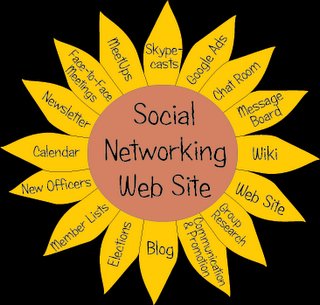
The model for our new group is based on the sunflower. The center of the sunflower is the core which contains the seeds and supports the petals. In our case, the center or core of the group is an online social networking web site which contains the member lists and supports (links to) the additional venues. The whole organization is internet based with the intention of utilizing the internet first and foremost for all the group's endeavors.
The group can still accommodate some traditional ways of doing things, but for the most part we're talking about a model that uses current technology available for free on the internet (with a few possible exceptions), that is user friendly and requires no knowledge of programming. Since is does away with the costs associated with printing and mailing traditional journals and newsletters (which is the single biggest line item for most genealogy groups), and it has options for raising money for other specific costs, basic membership to all is FREE. If a member still wants to receive their journals and newsletters in print they can pay for a premium membership (via PayPal) which would essentially cover the costs of on-demand printing and mailing of these items. I think you'll be surprised how many people will take online for free over printed for $$. D'ya think that allowing people to become members for free might increase your membership? I think so.
I'm going to focus here on the concept of the online social networking site as the core. For details about the "petals", you'll have to visit the genealogy wiki I created. I encourage you to visit my genealogy wiki and click on the link for the "The Sunflower Model for an Internet Based Genealogy Group". At the bottom of the page is a link where you can enter your comments or ask questions about the "petal items" or the model in general.
By the way, this is a legitmate wiki on the subject of genealogy (though it's just getting off the ground) so please consider becoming a contributor to it. Try it and see how easy it is to contribute an article to it. Browse through the categories I've created so far. Most are empty, just waiting for your contribution. You can create your own category as need be for your genealogy article, or just add a sub-page to a category already listed. And for those who are concerned about their privacy, you can do so anonymously. I've uploaded my bio that way so you can see that it's possible.
And now, back to the core of the group. The core is an online social networking site. If you don't know what that is, check out Wikipedia where you'll get a good explanation as well as a list of such sites. You'll have to do some looking and comparing because all these sites are not created equal. They usually offer a "bundle" or suite of features (some will be the "petals" in the Sunflower Model) but each site will offer different features in their bundles. Find one that's comfortable for the group you envision. Some offer more control, some less. It's worth putting some real time into investigating these options because once you set one up and start adding the "petals" you'll have a load of work on your hands to change it.
Most of these online social networking sites allow for "groups" or "families". You'll have to adapt them to your organization. I would also suggest looking at Famster and GenMates as possibilities.
Once you have your core established (your online social networking site set up), you can begin adding "petals". The beauty of the Sunflower Model for an internet based genealogy group is that there can be as many or as few petals as you want. The ones I have suggested in the model shown are ones I think every group should consider. But that doesn't mean you have to implement them all. Some may not work for your group. You may not have enough volunteers to monitor them all. Or, you may add "petals" that I haven't in my model. That's OK! The Sunflower is flexible.
So how does one go about adding the "petals"? First make a list of which "petals" you'd like your group to offer. Then look at what your core social networking site offers. If they have one of the features you want, good! Use the one they offer. If they don't, find a site that offers that service (you can find links to sites that offer just about all of these features in my previous posts). Create an account for your group there and link to it from your core site. And that's all there is to adding a "petal". So to clarify, you don't have all the features on one web site. You set them up individually as need be and link to them from your core site. Start with a few and add as you go.
Here's a list of the basic differences between using the Sunflower Model for an internet based genealogy group and a traditional genealogical society:
Online Gene Group:
With an online based group all members contribute content at will. So you lose the need for an editor and editorial staff and most of the responsibilities of the web master as well. You would need to add a tech consultant and several monitors. There's less program planning for face to face meetings but more coordination required for scheduled chat sessions or Skypecasts.
I think that about sums it up for the Sunflower Model. I'm curious about your thoughts. Comments?
Next we'll look at picking a new name for our newly redesigned group.
Most genealogical societies have as their main purpose to share and educate members about genealogical research methodology. Secondarily, most also see themselves as social opportunities for those interested in researching their family histories. Beyond that, purposes and definitions become more individualized for each organization.
...or have they?
Well, as a matter they need to. Here's where I propose a big dose of adaptation (read that: change). The first order of business is to change the priority of these purposes. Our new group (I'm going to refer to it as a "group" as opposed to a "genealogical society" from here on out because a part of our new model includes shedding the old image), will have as it's primary goal to be a social opportunity for people sharing an interest in learning about their family's history and secondarily to share and educate members about genealogical research methodology.
As previously discussed, people are drawn to online social networking web sites like MySpace.com. And not just kids, grownups too. Online dating sites like Match.com appeal to singles of all ages. And seniors have their own online communities at seniors.s5.com and OverFifties.com. Member growth on these types of sites is growing hugely. So our new model is going to start with a social networking site as the base we build our new group on. Yep, the group is internet based from the word go... because that's where our very import new pool of future members live.
Now don't go wrinkling your nose at the idea so fast. The model has merit. We start building it from an online social networking site but we don't end there...
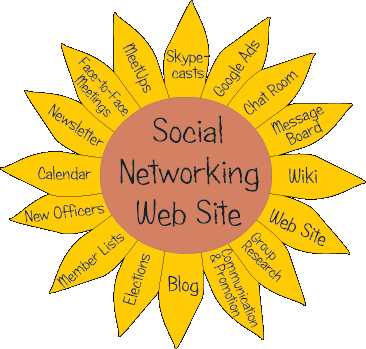
The model for our new group is based on the sunflower. The center of the sunflower is the core which contains the seeds and supports the petals. In our case, the center or core of the group is an online social networking web site which contains the member lists and supports (links to) the additional venues. The whole organization is internet based with the intention of utilizing the internet first and foremost for all the group's endeavors.
The group can still accommodate some traditional ways of doing things, but for the most part we're talking about a model that uses current technology available for free on the internet (with a few possible exceptions), that is user friendly and requires no knowledge of programming. Since is does away with the costs associated with printing and mailing traditional journals and newsletters (which is the single biggest line item for most genealogy groups), and it has options for raising money for other specific costs, basic membership to all is FREE. If a member still wants to receive their journals and newsletters in print they can pay for a premium membership (via PayPal) which would essentially cover the costs of on-demand printing and mailing of these items. I think you'll be surprised how many people will take online for free over printed for $$. D'ya think that allowing people to become members for free might increase your membership? I think so.
I'm going to focus here on the concept of the online social networking site as the core. For details about the "petals", you'll have to visit the genealogy wiki I created. I encourage you to visit my genealogy wiki and click on the link for the "The Sunflower Model for an Internet Based Genealogy Group". At the bottom of the page is a link where you can enter your comments or ask questions about the "petal items" or the model in general.
By the way, this is a legitmate wiki on the subject of genealogy (though it's just getting off the ground) so please consider becoming a contributor to it. Try it and see how easy it is to contribute an article to it. Browse through the categories I've created so far. Most are empty, just waiting for your contribution. You can create your own category as need be for your genealogy article, or just add a sub-page to a category already listed. And for those who are concerned about their privacy, you can do so anonymously. I've uploaded my bio that way so you can see that it's possible.
And now, back to the core of the group. The core is an online social networking site. If you don't know what that is, check out Wikipedia where you'll get a good explanation as well as a list of such sites. You'll have to do some looking and comparing because all these sites are not created equal. They usually offer a "bundle" or suite of features (some will be the "petals" in the Sunflower Model) but each site will offer different features in their bundles. Find one that's comfortable for the group you envision. Some offer more control, some less. It's worth putting some real time into investigating these options because once you set one up and start adding the "petals" you'll have a load of work on your hands to change it.
Most of these online social networking sites allow for "groups" or "families". You'll have to adapt them to your organization. I would also suggest looking at Famster and GenMates as possibilities.
Once you have your core established (your online social networking site set up), you can begin adding "petals". The beauty of the Sunflower Model for an internet based genealogy group is that there can be as many or as few petals as you want. The ones I have suggested in the model shown are ones I think every group should consider. But that doesn't mean you have to implement them all. Some may not work for your group. You may not have enough volunteers to monitor them all. Or, you may add "petals" that I haven't in my model. That's OK! The Sunflower is flexible.
So how does one go about adding the "petals"? First make a list of which "petals" you'd like your group to offer. Then look at what your core social networking site offers. If they have one of the features you want, good! Use the one they offer. If they don't, find a site that offers that service (you can find links to sites that offer just about all of these features in my previous posts). Create an account for your group there and link to it from your core site. And that's all there is to adding a "petal". So to clarify, you don't have all the features on one web site. You set them up individually as need be and link to them from your core site. Start with a few and add as you go.
Here's a list of the basic differences between using the Sunflower Model for an internet based genealogy group and a traditional genealogical society:
Online Gene Group:
- Primary way to meet with others is: Online, via chat sessions or Skypecasts.
- Primary way to distribute educational material is: Blog journal and wiki, updated 24/7
- Primary way for members to get advice/help: Message boards, chat sessions, and Skypecasts.
- Dues: None, group is self supporting through ads (May elect to receive journal and newsletter in printed form for a small fee. This would be on-demand printing of a PDF so the cost would be less that commercially published journals).
- Member accessiblility/input: Unlimited for most features.
- Access to group's "library" of information: Available online 24/7, searchable.
- Structure of the group: Flexible, spontaneous, input/contributions spread out among more people.
- Primary way to meet with others is: Face to face at scheduled meetings.
- Primary way to distribute educational material is: Monthly meetings, and in printed monthly/quarterly journals.
- Primary way for members to get advice/help: Monthly meetings in local area.
- Dues: Traditionally $15-$35 yr, depends on the society. Usually includes printed journal.
- Member accessiblility/input: Local monthy meetings, journal articles accepted by editor, or newsletter items.
- Access to group's "library" of information: Available to members who live in the local area, not searchable.
- Structure of the group: More control by executives, and editors.
With an online based group all members contribute content at will. So you lose the need for an editor and editorial staff and most of the responsibilities of the web master as well. You would need to add a tech consultant and several monitors. There's less program planning for face to face meetings but more coordination required for scheduled chat sessions or Skypecasts.
I think that about sums it up for the Sunflower Model. I'm curious about your thoughts. Comments?
Next we'll look at picking a new name for our newly redesigned group.
Technorati Tags:
Tuesday, August 22, 2006
Declining Membership in Genealogical Societies: A Vision for the Future Starting with Redefining the Membership Pool
Redesigning and reorganizing a genealogical society has to start with a vision. This vision is not limited to the mission of the organization but rather an image that encompasses who the members will be, how the group will function, as well as the purpose or mission of the group. For now we'll assume that the purposes of genealogical societies haven't changed from those I outlined in my post of August 15th. To reiterate:
So we'll leave that as is with the assumption that it still holds true and move on to look at the other aspects of our vision.
First let's look at who the current members of genealogical societies are with an eye towards increasing the membership. One common denominator among genealogical societies is the predominance of seniors on the membership rolls. In the past, genealogical societies were made up almost exclusively of seniors. Partly this was because younger people were too busy raising their own families or out partying to stop and think about the families of their ancestors and partly because it was a very time intensive hobby and many people didn't have that kind of time for a hobby until they retired. But that has changed tremendously with computers and the internet. Now younger people with families can fit in a half hour here and there to go online to do some searching. And web sites like EllisIsland.org, and Ancestry.com are making it easy to actually find a good bit of information in that half hour! Same is true for singles, and college students. And they are more likely to have some success (read that: get hooked) in a short period of time than in the days before computers. It hasn't come to the point yet where all of our genealogical research can be done online. But more and more information is available on the net every day. We're heading in that direction.
The reality is that the potential member pool that genealogical societies draw from today and have drawn from in the past, that being seniors without computer skills, is shrinking by natural attrition and by the availability of affordable computers and relatively easy access to computer user classes. The pool is shrinking and it will continue to shrink until it no longer exists because the next generation, the Baby Boomers, is pretty darn computer literate as a group. They've had to adapt to using computers as they've been phased-in in the workplace. They are retiring in droves or reducing their workload to part time. They have the time, the tools, and the skills to do genealogical research online. And their preferred "go to" place for research is the internet. It's becoming the "go to" place to socialize as well. So guess what? If genealogical societies want to stay in business they'd better find a way to tap into this pool of potential members. And they better be ready to play their game with computer skills being a given or they won't be able to attract them or keep them as members.
And behind the Baby Boomers are Gen Xers and Gen Yers. These folks grew up with computers and video games in the home as well as at work. You won't have to bring them up to speed on computer skills to do genealogical research. Just point them in the right direction and off they'll go, stopping now and then at an online chat room or message board for some advice along the way. These are the potential genealogical society members of tomorrow. But they can also be members today if you market to them, and if you don't frustrate them with the traditional research and education methods of old.
A good many of these younger potential members are used to Nintendo and Xbox games that require quick reflexes and instant feedback. They are used to much more immediate gratification than the seniors of today are. If you're going to capture and hold their interest and membership you'd better be ready with a whole new model for genealogical societies, because they're not going to wait until next month to attend your face-to-face traditional meeting or next quarter to read your journal.
Of course there are those who will be quick to remind me that most people will still need to research beyond what is available online. And that's absolutely true. But it's also true that with each new database or document that goes online the ultimate length of time it takes to make substantial progress on their family tree is shortening. There are less and less documents that have to be found on microfilm or requested by snail mail. The LDS has already started their project of putting all of their many, many thousands of rolls of microfilmed documents online. This is a one way street folks. There's no going back to the old way of doing things.
So what does all this mean in terms of gaining members? It means that genealogical societies need to broaden their outreach to include people not considered likely candidates for memberships in the past. They must pump new blood into their organizations from a huge pool of potential members out there that they can't afford to ignore. They must change their orientation from traditional to adaptive. They must announce, advertise, and promote their groups where the potential member pool lives. We're talking, cafes and coffee houses, college campuses, recreation centers, workout facilities, and online of course (see my previous post of August 18th) in addition to the more traditional places like church bulletins, community newsletters, and public libraries.
Is that it? Is it as simple as redfining our member base? Do we just promote/advertise our societies to this new pool of members and they'll jump on board? Well, no. It's not that simple. You have to make your organization appealing to them. You have be the kind of organization that they want to join.
Next we'll look at a new model for a reorganized genealogical society and how it would function with the goal of appealing to this new pool of potential members.
Most genealogical societies have as their main purpose to share and educate members about genealogical research methodology. Secondarily, most also see themselves as social opportunities for those interested in researching their family histories. Beyond that, purposes and definitions become more individualized for each organization.
So we'll leave that as is with the assumption that it still holds true and move on to look at the other aspects of our vision.
First let's look at who the current members of genealogical societies are with an eye towards increasing the membership. One common denominator among genealogical societies is the predominance of seniors on the membership rolls. In the past, genealogical societies were made up almost exclusively of seniors. Partly this was because younger people were too busy raising their own families or out partying to stop and think about the families of their ancestors and partly because it was a very time intensive hobby and many people didn't have that kind of time for a hobby until they retired. But that has changed tremendously with computers and the internet. Now younger people with families can fit in a half hour here and there to go online to do some searching. And web sites like EllisIsland.org, and Ancestry.com are making it easy to actually find a good bit of information in that half hour! Same is true for singles, and college students. And they are more likely to have some success (read that: get hooked) in a short period of time than in the days before computers. It hasn't come to the point yet where all of our genealogical research can be done online. But more and more information is available on the net every day. We're heading in that direction.
The reality is that the potential member pool that genealogical societies draw from today and have drawn from in the past, that being seniors without computer skills, is shrinking by natural attrition and by the availability of affordable computers and relatively easy access to computer user classes. The pool is shrinking and it will continue to shrink until it no longer exists because the next generation, the Baby Boomers, is pretty darn computer literate as a group. They've had to adapt to using computers as they've been phased-in in the workplace. They are retiring in droves or reducing their workload to part time. They have the time, the tools, and the skills to do genealogical research online. And their preferred "go to" place for research is the internet. It's becoming the "go to" place to socialize as well. So guess what? If genealogical societies want to stay in business they'd better find a way to tap into this pool of potential members. And they better be ready to play their game with computer skills being a given or they won't be able to attract them or keep them as members.
And behind the Baby Boomers are Gen Xers and Gen Yers. These folks grew up with computers and video games in the home as well as at work. You won't have to bring them up to speed on computer skills to do genealogical research. Just point them in the right direction and off they'll go, stopping now and then at an online chat room or message board for some advice along the way. These are the potential genealogical society members of tomorrow. But they can also be members today if you market to them, and if you don't frustrate them with the traditional research and education methods of old.
A good many of these younger potential members are used to Nintendo and Xbox games that require quick reflexes and instant feedback. They are used to much more immediate gratification than the seniors of today are. If you're going to capture and hold their interest and membership you'd better be ready with a whole new model for genealogical societies, because they're not going to wait until next month to attend your face-to-face traditional meeting or next quarter to read your journal.
Of course there are those who will be quick to remind me that most people will still need to research beyond what is available online. And that's absolutely true. But it's also true that with each new database or document that goes online the ultimate length of time it takes to make substantial progress on their family tree is shortening. There are less and less documents that have to be found on microfilm or requested by snail mail. The LDS has already started their project of putting all of their many, many thousands of rolls of microfilmed documents online. This is a one way street folks. There's no going back to the old way of doing things.
So what does all this mean in terms of gaining members? It means that genealogical societies need to broaden their outreach to include people not considered likely candidates for memberships in the past. They must pump new blood into their organizations from a huge pool of potential members out there that they can't afford to ignore. They must change their orientation from traditional to adaptive. They must announce, advertise, and promote their groups where the potential member pool lives. We're talking, cafes and coffee houses, college campuses, recreation centers, workout facilities, and online of course (see my previous post of August 18th) in addition to the more traditional places like church bulletins, community newsletters, and public libraries.
Is that it? Is it as simple as redfining our member base? Do we just promote/advertise our societies to this new pool of members and they'll jump on board? Well, no. It's not that simple. You have to make your organization appealing to them. You have be the kind of organization that they want to join.
Next we'll look at a new model for a reorganized genealogical society and how it would function with the goal of appealing to this new pool of potential members.
Technorati Tags:
Monday, August 21, 2006
Declining Membership in Genealogical Societies: The Ugly Truth
This is going to be a hard pill for some to swallow but here it is. Genealogical societies are made up of a bunch of old people who get their kicks from looking for the records of dead people.
OK, there I've said in print what most people (who aren't one of "us") think about genealogical societies. And it's hard to argue with the truth. Genealogical societies are in fact made up mostly of the over 60 crowd, the AARP crowd, the retired crowd. And in fact, the object of the game so to speak is to find records of people long into the hereafter. It's a perfectly respectable hobby, and those of us who are addicted to it can't understand why everyone else isn't. So, why is it that it sounds so unappealing to everyone?
The truth is, genealogical societies have an image problem. Our American society is phobic of old age. Think about it for a minute. Every other ad we see is for anti-wrinkle cream, plastic surgery... to look years younger, or hair color ads... to cover the gray. It's not fair, it's not right, but people will go to extreme lengths to avoid being associated with old age. In our society, youth is valued, old age is not. It's sad. It's very, very sad. But it's true.
In a recent Reuter's article we find a perfect example of this. "Sixty may be the new 40 but Bill Clinton hates it". Here we have a former President of the United States about to celebrate his 60th birthday and he's bummed about it, hates it in fact. "60 is the new 40" has become the mantra of baby boomers that are turning 60. They don't want to think of themselves as "old" so in essence they are propagating this image that 60 isn't so bad, in fact, it's just like being 40 again. So really, you shouldn't think of them as being old. Right. (The word "denial" comes to mind here.)
So, one aspect of the perception of genealogical societies that might be contributing to the decline in membership is that people may be resistant to joining a group perceived as being for old people. Another aspect of the image that has problems is the whole "looking for records" thing. Looking for records isn't sexy. It isn't exciting. And it isn't "cool". In fact, to most people's way of thinking it sounds boring. (Of course they've never experienced the Happy Dance we do when we've found that one document that gets us over the brick wall, so we have to be tolerant of their naivete ;-)
But seriously folks, looking for records isn't appealing. There's no cache there. Open a file drawer and invite someone you know to go looking for records and see if their face lights up with glee. Not gonna happen. "Solving a mystery" is cool, "sleuthing" is cool, "looking for records", is not cool. But genealogical research is really all of those things isn't it? But the images are so very different.
Is it important to be cool? It's important to be something that has positive attributes associated with it if you want new blood in your group. If it's fun to join, people will flock to your group. Just take a look at MySpace.com and you'll discover a group that isn't having membership problems. The website attracts 500,000 new members each week according to Wikipedia. And contrary to popular belief, it ain't all kids either!
The last point I would like to make on this subject is that the words "genealogical society" have a stuffy, scientific, academic, antiquated, and elitist sound to them. And just about every genealogical society has those words somewhere in its name. What's wrong with that? Nothing if that's the image you want people (read that: potential members) to have about your group. Is it? Or do you want people to think your group is personable, approachable, friendly, warm, fun, helpful, and family oriented?
It's time for a change. It's time for new thinking. It's time to redefine our groups and the way we've been doing things. Having a group of older people, with an academic and stuffy image, looking for records of deceased ancestors is an image whose time has come... and gone. It's time for an image makeover. This is a case of the old axiom, "if you can't beat 'em, join 'em". We aren't going to be able to reverse the tide of public opinion and convince everyone that being with old people and looking for records of dead people is cool. But we can redefine our groups as "search-happy sleuths seeking the gene line". Now see, doesn't that give a happier, friendlier, no-specific-age, and more fun connotation? No, I'm not suggesting that as a name but as a different way of seeing ourselves and our societies. It's all about marketing, my dears.
Next we'll look at redefining and reorganizing genealogical societies from the inside out. Time for a fresh coat of paint!
OK, there I've said in print what most people (who aren't one of "us") think about genealogical societies. And it's hard to argue with the truth. Genealogical societies are in fact made up mostly of the over 60 crowd, the AARP crowd, the retired crowd. And in fact, the object of the game so to speak is to find records of people long into the hereafter. It's a perfectly respectable hobby, and those of us who are addicted to it can't understand why everyone else isn't. So, why is it that it sounds so unappealing to everyone?
The truth is, genealogical societies have an image problem. Our American society is phobic of old age. Think about it for a minute. Every other ad we see is for anti-wrinkle cream, plastic surgery... to look years younger, or hair color ads... to cover the gray. It's not fair, it's not right, but people will go to extreme lengths to avoid being associated with old age. In our society, youth is valued, old age is not. It's sad. It's very, very sad. But it's true.
In a recent Reuter's article we find a perfect example of this. "Sixty may be the new 40 but Bill Clinton hates it". Here we have a former President of the United States about to celebrate his 60th birthday and he's bummed about it, hates it in fact. "60 is the new 40" has become the mantra of baby boomers that are turning 60. They don't want to think of themselves as "old" so in essence they are propagating this image that 60 isn't so bad, in fact, it's just like being 40 again. So really, you shouldn't think of them as being old. Right. (The word "denial" comes to mind here.)
So, one aspect of the perception of genealogical societies that might be contributing to the decline in membership is that people may be resistant to joining a group perceived as being for old people. Another aspect of the image that has problems is the whole "looking for records" thing. Looking for records isn't sexy. It isn't exciting. And it isn't "cool". In fact, to most people's way of thinking it sounds boring. (Of course they've never experienced the Happy Dance we do when we've found that one document that gets us over the brick wall, so we have to be tolerant of their naivete ;-)
But seriously folks, looking for records isn't appealing. There's no cache there. Open a file drawer and invite someone you know to go looking for records and see if their face lights up with glee. Not gonna happen. "Solving a mystery" is cool, "sleuthing" is cool, "looking for records", is not cool. But genealogical research is really all of those things isn't it? But the images are so very different.
Is it important to be cool? It's important to be something that has positive attributes associated with it if you want new blood in your group. If it's fun to join, people will flock to your group. Just take a look at MySpace.com and you'll discover a group that isn't having membership problems. The website attracts 500,000 new members each week according to Wikipedia. And contrary to popular belief, it ain't all kids either!
The last point I would like to make on this subject is that the words "genealogical society" have a stuffy, scientific, academic, antiquated, and elitist sound to them. And just about every genealogical society has those words somewhere in its name. What's wrong with that? Nothing if that's the image you want people (read that: potential members) to have about your group. Is it? Or do you want people to think your group is personable, approachable, friendly, warm, fun, helpful, and family oriented?
It's time for a change. It's time for new thinking. It's time to redefine our groups and the way we've been doing things. Having a group of older people, with an academic and stuffy image, looking for records of deceased ancestors is an image whose time has come... and gone. It's time for an image makeover. This is a case of the old axiom, "if you can't beat 'em, join 'em". We aren't going to be able to reverse the tide of public opinion and convince everyone that being with old people and looking for records of dead people is cool. But we can redefine our groups as "search-happy sleuths seeking the gene line". Now see, doesn't that give a happier, friendlier, no-specific-age, and more fun connotation? No, I'm not suggesting that as a name but as a different way of seeing ourselves and our societies. It's all about marketing, my dears.
Next we'll look at redefining and reorganizing genealogical societies from the inside out. Time for a fresh coat of paint!
Technorati Tags:
Friday, August 18, 2006
Declining Membership in Genealogical Societies: Promoting Your Organization with Technology
A big part of attracting new members to a genealogical society is self promotion. People are naturally attracted to more dynamic and diverse groups than those that appear to have little going on. What you show the world is what they will think of you. One way to show what your organization is about is with an attractive, frequently updated web site (frequent updates suggest there's more going on with the group). Fortunately, these days most genealogical societies have a web site although the site may not be advertising or promoting them as well as it could be. Being as I'm a professional web site designer and search engine marketer, I could go on and on about how to improve your society's web site but that's for another post on another day. Webmasters beware... your day is coming ;-) In the meantime, I'd to highlight newsletters, online communities, and blog carnivals as ways of advertising and promoting genealogical societies.
One of the best and most under utilized ways of promoting a genealogical society is with a newsletter. Preferably an online newsletter. And the newsletter should be distributed for free to anyone who signs up for it on the society's web site. This is a great way to advertise and promote your organization to a group who by virtue of the fact that they've sign up for the newsletter are telling you they're interested in your group.
Treat the newsletter as the face your organization shows the world. Create excitement with your words and make sure the flavor of the newsletter is always positive. This is not to encourage insincerity but rather to stop and think about how things are phrased. People will naturally feel more favorable towards a group that presents itself as a happy, positive, energetic group of people.
Besides having a positive outlook and sounding exciting, a newsletter should always promote the people who make up the group. By this I mean you should mention the names (genealogists love surnames!) of members who have done something… anything. Just get members' names in print.
One idea is to do a profile on a different member with each issue. Keep it short but make it personal (not giving out personal contact information though!) giving an overview of that person's length of involvement with the group, their research successes to date, what they contribute to the organization and what they appreciate the most about the organization. This will give newsletter subscribers a feel for what kinds of contributions members make and what they get out of the group. It may give them ideas about getting involved, what they may be able to contribute, and what they stand to gain from participating themselves. Look at it as a means of recruiting new members while getting the word out about the latest society news.
Remember, people who are interested in genealogy are interested in people. So each issue of a newsletter should highlight a person, but be careful not to over do it. The newsletter isn't a grandstand opportunity for people's life stories. It's more about telling the world what great people you have in your organization. So stick with talking about the person's involvement with the organization.
Another good idea for newsletter content is promoting upcoming events. Remind people of meetings, conferences, etc. But it's equally a good idea to talk about recent past events. Write up a review about the speaker at the last meeting, include links to their personal web sites or to sites they discussed in the meeting. If they are a published author, be sure to include information about their book and where it can be purchased.
Of course it's always good to pass on information about newsworthy items that are relevant to your society's area of specialization. So you want to do that too.
Probably the most important thing you want to include in your newsletter is what was discussed at the last meeting of the organization's officers and the agenda for the next meeting. This is vitally important information because it speaks volumes about your organization. If you are discussing taking on a new group project, or who to invite as speakers for the annual seminar, or possibly expanding the content on the society's web site, or whatever, let everyone know! Not only are you more likely to get helpful feedback (if you know what people want and can deliver it to them you’re more likely to keep them as members or get them as members!) but you're also showing them that you are discussing serious matters at the meetings and not just having a coffee klatch. And people just love to know what's going on behind the scenes… think about all the reality TV shows that show what goes on behind closed doors in people's lives. People eat that stuff up. Inquiring minds want to know ;-)
Keep in mind too that the more different things you put in your newsletter, the busier and more active your group looks. It's not about more words on the page but more items in the newsletter. If the item takes more than 2 paragraphs (3 tops) it doesn't belong in a newsletter. The information would be better presented in a different medium such as a blog post.
The key to a good newsletter is to have it promote your group with a positive, active image, while conveying timely topical information. Use it to get people excited about your organization and they'll be more likely to join or happier that they did. This is a great opportunity to advertise and promote your society. Do it!
Next I'd like to touch on online communities. They have become cyber meeting places for people with common interests. They are a tool to socially connect with others and they have become a favorite online space for the under 30 age group. But there's no reason that genealogical societies can't create online communities where members can interact as well. Sometimes the most interesting conversations take place spontaneously between people who find themselves in the same place at the same time. Dick Eastman has his chat room open 24/7 for people to discuss, whatever. But he also has prearranged chat sessions too. It's a meeting place. It's an online community.
Yahoo Groups are a great invention. While they don't offer online chats (you can do this in Yahoo Messenger), they do offer a great way for genealogical societies to offer a host of sharing venues with no programming knowledge needed. Set up a group and you can control who enters, post messages (and send group email), photos, files, databases, calendar events, and more. This could make a wonderful online community for a genealogical society. It will be listed with the Yahoo Group directory and it becomes another form of advertising and promotion for the organization.
Did you know that genealogists now have their own dedicated online community? It's the equivalent to MySpace.com but for those who share a passion for genealogy! The site I'm talking about is GenMates.com and it would be a terrific place to set up a genealogical society online community. I've mentioned it in a previous blog. Check it out and think about the possibilities. It's great exposure and a great promotion for those who are willing to give it a try.
And lastly I'd like to mention carnival blogs. Carnival blogs are actually a collection of references (text and links) to blog posts on a specific topic. One blogger hosts the carnival and picks a topic. It gets listed/announced at blogcarnival.com. Other bloggers then submit blog posts they've written on the topic. The hosting blogger collects all the submitted posts (and usually collects some they find on their own) and publishes the whole kit and caboodle on their blog on a given date. This is another ideal way for a genealogical society to advertise and promote their organization. Start a carnival and rotate hosts among group members. Other carnival watchers and bloggers will find it and you'll increase your group’s exposure. It's great advertising to sponsor a carnival! By the way, I have started a carnival, the Carnival of Genealogy, which is published twice a month. You can check out the details on the blog carnival web site and check out carnival editions one, two, three, four, five. My next post will actually be another edition of the Carnival of Genealogy. The topic is… genealogical societies!
So now we've looked at using newsletters, online communities, and blog carnivals as ways to advertise and promote genealogical societies. Next week I'll get to the more radical stuff so come back and visit my blog then!
One of the best and most under utilized ways of promoting a genealogical society is with a newsletter. Preferably an online newsletter. And the newsletter should be distributed for free to anyone who signs up for it on the society's web site. This is a great way to advertise and promote your organization to a group who by virtue of the fact that they've sign up for the newsletter are telling you they're interested in your group.
Treat the newsletter as the face your organization shows the world. Create excitement with your words and make sure the flavor of the newsletter is always positive. This is not to encourage insincerity but rather to stop and think about how things are phrased. People will naturally feel more favorable towards a group that presents itself as a happy, positive, energetic group of people.
Besides having a positive outlook and sounding exciting, a newsletter should always promote the people who make up the group. By this I mean you should mention the names (genealogists love surnames!) of members who have done something… anything. Just get members' names in print.
One idea is to do a profile on a different member with each issue. Keep it short but make it personal (not giving out personal contact information though!) giving an overview of that person's length of involvement with the group, their research successes to date, what they contribute to the organization and what they appreciate the most about the organization. This will give newsletter subscribers a feel for what kinds of contributions members make and what they get out of the group. It may give them ideas about getting involved, what they may be able to contribute, and what they stand to gain from participating themselves. Look at it as a means of recruiting new members while getting the word out about the latest society news.
Remember, people who are interested in genealogy are interested in people. So each issue of a newsletter should highlight a person, but be careful not to over do it. The newsletter isn't a grandstand opportunity for people's life stories. It's more about telling the world what great people you have in your organization. So stick with talking about the person's involvement with the organization.
Another good idea for newsletter content is promoting upcoming events. Remind people of meetings, conferences, etc. But it's equally a good idea to talk about recent past events. Write up a review about the speaker at the last meeting, include links to their personal web sites or to sites they discussed in the meeting. If they are a published author, be sure to include information about their book and where it can be purchased.
Of course it's always good to pass on information about newsworthy items that are relevant to your society's area of specialization. So you want to do that too.
Probably the most important thing you want to include in your newsletter is what was discussed at the last meeting of the organization's officers and the agenda for the next meeting. This is vitally important information because it speaks volumes about your organization. If you are discussing taking on a new group project, or who to invite as speakers for the annual seminar, or possibly expanding the content on the society's web site, or whatever, let everyone know! Not only are you more likely to get helpful feedback (if you know what people want and can deliver it to them you’re more likely to keep them as members or get them as members!) but you're also showing them that you are discussing serious matters at the meetings and not just having a coffee klatch. And people just love to know what's going on behind the scenes… think about all the reality TV shows that show what goes on behind closed doors in people's lives. People eat that stuff up. Inquiring minds want to know ;-)
Keep in mind too that the more different things you put in your newsletter, the busier and more active your group looks. It's not about more words on the page but more items in the newsletter. If the item takes more than 2 paragraphs (3 tops) it doesn't belong in a newsletter. The information would be better presented in a different medium such as a blog post.
The key to a good newsletter is to have it promote your group with a positive, active image, while conveying timely topical information. Use it to get people excited about your organization and they'll be more likely to join or happier that they did. This is a great opportunity to advertise and promote your society. Do it!
Next I'd like to touch on online communities. They have become cyber meeting places for people with common interests. They are a tool to socially connect with others and they have become a favorite online space for the under 30 age group. But there's no reason that genealogical societies can't create online communities where members can interact as well. Sometimes the most interesting conversations take place spontaneously between people who find themselves in the same place at the same time. Dick Eastman has his chat room open 24/7 for people to discuss, whatever. But he also has prearranged chat sessions too. It's a meeting place. It's an online community.
Yahoo Groups are a great invention. While they don't offer online chats (you can do this in Yahoo Messenger), they do offer a great way for genealogical societies to offer a host of sharing venues with no programming knowledge needed. Set up a group and you can control who enters, post messages (and send group email), photos, files, databases, calendar events, and more. This could make a wonderful online community for a genealogical society. It will be listed with the Yahoo Group directory and it becomes another form of advertising and promotion for the organization.
Did you know that genealogists now have their own dedicated online community? It's the equivalent to MySpace.com but for those who share a passion for genealogy! The site I'm talking about is GenMates.com and it would be a terrific place to set up a genealogical society online community. I've mentioned it in a previous blog. Check it out and think about the possibilities. It's great exposure and a great promotion for those who are willing to give it a try.
And lastly I'd like to mention carnival blogs. Carnival blogs are actually a collection of references (text and links) to blog posts on a specific topic. One blogger hosts the carnival and picks a topic. It gets listed/announced at blogcarnival.com. Other bloggers then submit blog posts they've written on the topic. The hosting blogger collects all the submitted posts (and usually collects some they find on their own) and publishes the whole kit and caboodle on their blog on a given date. This is another ideal way for a genealogical society to advertise and promote their organization. Start a carnival and rotate hosts among group members. Other carnival watchers and bloggers will find it and you'll increase your group’s exposure. It's great advertising to sponsor a carnival! By the way, I have started a carnival, the Carnival of Genealogy, which is published twice a month. You can check out the details on the blog carnival web site and check out carnival editions one, two, three, four, five. My next post will actually be another edition of the Carnival of Genealogy. The topic is… genealogical societies!
So now we've looked at using newsletters, online communities, and blog carnivals as ways to advertise and promote genealogical societies. Next week I'll get to the more radical stuff so come back and visit my blog then!
Technorati Tags:
Thursday, August 17, 2006
Declining Membership in Genealogical Societies: More Options for Making Your Society More Accessible
There are a lot of internet technologies available for genealogical societies to take advantage of. In the previous post, we looked at blogs, forums, and online chats. This time around we’ll look at podcasts, Skypecasts, and wikis. These are newer technologies though they certainly aren’t brand new. They’ve been around for a few years but are just catching on and being adapted for genealogy purposes.
Podcasting is catching on really fast, just ask anyone under the age of 30 ;-) Essentially, a podcast is an audio or video “program” digitally recorded for playback on an iPod or any computer. Yes, that’s right. You can play podcasts on any computer. Contrary to popular belief, they don’t require an iPod to play them. I liken podcasts to listening to the old time radio programs. The difference is they aren’t broadcast over the air waves; you download them to your computer and play them there. There are a couple of genealogy-topic podcasts being produced on a regular basis now. You can check them out at The Genealogy Tech Podcast and The Genealogy Guys Podcast web sites. Ken Aitken recently posted about a major archive that is now using podcasts in a very clever way. Check it out and think about the possibilities for genealogical societies... lectures available for download from society web sites.
Making a podcast takes a little time and practice. But like anything else, it gets easier with practice. You need some audio editing software, like Audacity, and an explanation of how to create and distribute your podcast. You can get that at PodCastingNews.com. Podcasts would be an excellent way to bring genealogy meetings to those who physically can’t attend. They are a one-way lecture format ideally suited to record meetings and seminars. This is the next best way to make your genealogical society more accessible to the members. And once again, it gives them something they can’t get elsewhere (unless they can attend the meeting or seminar in person).
And now on to Skypecasts. Skypecasts, are for all intents and purposes, the same as online chats except that they utilize VoIP (voice over internet protocol) technology. Which means they are audio instead of type chatting. Think of it as a group phone call or a conference call for, oh, a 100 people or so. To be fair, Skype is only one company that offers this technology. Ken Aitken wrote a blog post about FreeConferenceCall.com a while back. More recently Dick Eastman has been experimenting with this technology and has had participants from all over the globe. It’s just like talking on the phone. Well, almost. It’s free to everyone everywhere but you do have to download the Skype software (which is very easy to do), and you do have to have a microphone (under $10 at RadioShack) or headset to hook up to your computer.
This technology is best suited to a lecture-then-Q&A format. It’s kind of chaotic when everyone has the floor at the same time (lots of distracting background noise too). But if a moderator/host/speaker were to give a talk on a specific topic for say 20-30 minutes or so and then take questions from listeners (who can “request the mike”), it would work out very well. The entire audio program can be recorded for playback too. This is another great example of how genealogical societies can reach out to their members and give them something they can’t get elsewhere… real time Q&A sessions for free, even from across the globe!
And last but not least, I’d like to touch on the subject of wikis. A wiki is a type of web site that allows users to view, edit, or contribute information. Probably the best known wiki is Wikipedia.org, a free-content encyclopedia. Many of the links in this post and the previous post were to Wikipedia.org pages.
Genealogical societies could set up and use a wiki for their own field of specialization. If, for instance, your society is ethnically based, say for instance Polish genealogy. You could set up a wiki for Polish genealogy. You could then offer to let members (or the public) contribute information relevant to Polish genealogy… information on historical events, cities, villages, churches, and famous people in Poland. It would become a resource site not just for links to other sites (like Cyndi’s List) but for actual content. Once again the beauty here is that one person isn’t responsible for creating and uploading the content. It gets created and updated by anyone, or by designated members only. However you choose to do it. You create a repository for information related specifically to your organization's area of specialization. You become the "go-to" source for information on that topic without having to do all the work.
You can set up a wiki at a “wiki farm”. Check out a list of wiki farms at Wikepedia.org. Not all of them are free but many of them are.
So now we’ve looked at three more venues for sharing information, increasing your society’s accessibility, and having more to offer your members and potential members. All of these venues allow you to control who can take advantage of them, so you can potentially offer them to members only. These then are more ways to attract new members and keep those already on your member rolls. For more information about these ideas you might want to check out a book called Blogs, Wikis, Podcasts, and Other Powerful Web Tools for Classrooms which Ken Aitken blogged about. I haven't read the book myself but plan to.
Next we’ll look at newsletters, online communities and carnival blogs to see how they can be used to promote your genealogical society.
Podcasting is catching on really fast, just ask anyone under the age of 30 ;-) Essentially, a podcast is an audio or video “program” digitally recorded for playback on an iPod or any computer. Yes, that’s right. You can play podcasts on any computer. Contrary to popular belief, they don’t require an iPod to play them. I liken podcasts to listening to the old time radio programs. The difference is they aren’t broadcast over the air waves; you download them to your computer and play them there. There are a couple of genealogy-topic podcasts being produced on a regular basis now. You can check them out at The Genealogy Tech Podcast and The Genealogy Guys Podcast web sites. Ken Aitken recently posted about a major archive that is now using podcasts in a very clever way. Check it out and think about the possibilities for genealogical societies... lectures available for download from society web sites.
Making a podcast takes a little time and practice. But like anything else, it gets easier with practice. You need some audio editing software, like Audacity, and an explanation of how to create and distribute your podcast. You can get that at PodCastingNews.com. Podcasts would be an excellent way to bring genealogy meetings to those who physically can’t attend. They are a one-way lecture format ideally suited to record meetings and seminars. This is the next best way to make your genealogical society more accessible to the members. And once again, it gives them something they can’t get elsewhere (unless they can attend the meeting or seminar in person).
And now on to Skypecasts. Skypecasts, are for all intents and purposes, the same as online chats except that they utilize VoIP (voice over internet protocol) technology. Which means they are audio instead of type chatting. Think of it as a group phone call or a conference call for, oh, a 100 people or so. To be fair, Skype is only one company that offers this technology. Ken Aitken wrote a blog post about FreeConferenceCall.com a while back. More recently Dick Eastman has been experimenting with this technology and has had participants from all over the globe. It’s just like talking on the phone. Well, almost. It’s free to everyone everywhere but you do have to download the Skype software (which is very easy to do), and you do have to have a microphone (under $10 at RadioShack) or headset to hook up to your computer.
This technology is best suited to a lecture-then-Q&A format. It’s kind of chaotic when everyone has the floor at the same time (lots of distracting background noise too). But if a moderator/host/speaker were to give a talk on a specific topic for say 20-30 minutes or so and then take questions from listeners (who can “request the mike”), it would work out very well. The entire audio program can be recorded for playback too. This is another great example of how genealogical societies can reach out to their members and give them something they can’t get elsewhere… real time Q&A sessions for free, even from across the globe!
And last but not least, I’d like to touch on the subject of wikis. A wiki is a type of web site that allows users to view, edit, or contribute information. Probably the best known wiki is Wikipedia.org, a free-content encyclopedia. Many of the links in this post and the previous post were to Wikipedia.org pages.
Genealogical societies could set up and use a wiki for their own field of specialization. If, for instance, your society is ethnically based, say for instance Polish genealogy. You could set up a wiki for Polish genealogy. You could then offer to let members (or the public) contribute information relevant to Polish genealogy… information on historical events, cities, villages, churches, and famous people in Poland. It would become a resource site not just for links to other sites (like Cyndi’s List) but for actual content. Once again the beauty here is that one person isn’t responsible for creating and uploading the content. It gets created and updated by anyone, or by designated members only. However you choose to do it. You create a repository for information related specifically to your organization's area of specialization. You become the "go-to" source for information on that topic without having to do all the work.
You can set up a wiki at a “wiki farm”. Check out a list of wiki farms at Wikepedia.org. Not all of them are free but many of them are.
So now we’ve looked at three more venues for sharing information, increasing your society’s accessibility, and having more to offer your members and potential members. All of these venues allow you to control who can take advantage of them, so you can potentially offer them to members only. These then are more ways to attract new members and keep those already on your member rolls. For more information about these ideas you might want to check out a book called Blogs, Wikis, Podcasts, and Other Powerful Web Tools for Classrooms which Ken Aitken blogged about. I haven't read the book myself but plan to.
Next we’ll look at newsletters, online communities and carnival blogs to see how they can be used to promote your genealogical society.
Technorati Tags:
Subscribe to:
Posts (Atom)