It's been a long time since I've posted anything here. It will be interesting to see if I get any comments... will my blog still appear in anyone's feed reader??? LOL!
Every year or so I subscribe to Ancestry.com for a month to see what's new and hopefully add some info to my family tree. There's usually not much new and not much to add, so this time around I decided to use that month of Ancestry access to help out a friend by researching her family history. I knew this would be challenging for me because this friend has no Polish ancestors and that's all I have experience in researching. But what the heck, it was time to jump back into my genealogy research and this seemed like a good way to get my feet wet.
I started with my friend's father's line which is French Canadian. The family records from the Essex County, Ontario area were pretty easy to find and it was fun to be on the hunt and entering data in a database again. Before too long, the family records went back to Quebec. Now that was a bit more challenging for me. My French language skills are more than rusty, they're very limited. I had French language classes in grades 4-7 and not since then. But with the help of good ole Google Translate, I made pretty good progress and was able to take a couple of her family lines back to the late 1600s in the Quebec area.
When I'd taken that French Canadian research as far as I could (basically, what I could find online at Ancestry.com and FamilySearch.org) I moved on to my friend's mother's line which is English. I've dabbled in researching English records before but it has been a looong while. Ancestry has a few more collections than the last time I was looking for records so that's nice. I had great fun going through the records and discovering the charming street and neighborhood names... like Cold Bath Lane. Wouldn't it be fun to give your address on Cold Bath Lane? Cute!
I was just finishing up with the research of my friend's English lines, and coming to the end of my one-month Ancestry subscription, when Ancestry released the new batch of Michigan Marriage Records 1867-1952. Woo hoo! A serious new collection for me to examine for my own family lines! My one-month subscription to Ancestry just became a two-month subscription.
I'm feeling good about the research I did for my friend. If she wants to take things further she can start reading about Canadian history and pick up some Charles Dickens' novels to learn more about those periods of her ancestors' lives. I know there are probably more (and maybe better) sources for online research for Canadian and English records than just Ancestry and FamilySearch. If you know of some, please leave a comment and I will pass the info along to my friend. Now that I've gotten her started, perhaps she'll want to take the research further.
I was working on that English research at the same time I started binge-watching the "Mr. Selfridge" television series. Now I'm hooked on that series! Love it! Can't wait for Season 3 to begin next month!
Showing posts with label Michigan. Show all posts
Showing posts with label Michigan. Show all posts
Thursday, February 26, 2015
Thursday, May 10, 2012
I've Become One Of Them...

Or laugh if that suits you better. ;-)
After indexing thousands of records for FamilySearch, I took the plunge. Yes, I've become a FamilySearch arbitrator. As of today I've arbitrated just over a thousand names. That's not a lot compared to those who have been arbitrating for years or even months. But I feel like I'm out of the "newbie" category now. I thought I'd share a few of my thoughts and observations on the 1940 Census project since that's entirely what my indexing and arbitrating efforts are focused on at this point.
Indexing
I suspect there will be more "errors" in the finished product (the index for the 1940 Census that will appear on FamilySearch.org, FindMyPast.com and Archives.com) than for previous Census years. The reason for this is the poor image quality we indexers are working with. In addition to having to decipher a zillion different enumerators' handwriting, as is always the case with census records, we also have to try to read unfocused camera images. As someone who never leaves the house without a camera, I'm very attuned to focus issues. When handwriting is out of focus it creates ghosting. It's almost like having double vision. It complicates deciphering even the most precise printing and can make sloppy handwriting beyond difficult to decipher. I find deciphering ghosted handwriting much more difficult than deciphering sloppy handwriting or handwriting using "old" letter forms. There are samples galore of "old" handwriting styles to reference but I've not seen any for deciphering ghosted images. Fortunately, not all the pages are out of focus. But I would go so far as to say that most pages have some soft or blurred sections and some pages have focus issues throughout. If you've tried to look for family members among the 1940 Census images posted online you know what I mean.
Fortunately, the folks at FamilySearch have a procedure for dealing with indexing errors. When you find one (after the indexes are published) you will be able to send them a correct/alternative spelling. I suspect there will be a lot of that going on. Hey, we're all doing the best that we can but you can't make a silk purse out of a sow's ear.
Arbitrating
I erroneously assumed that the most common errors I would be correcting as an arbitrator would be differences of opinion on letters within a name/location. But my experience has been that the most common errors I'm correcting are typos. Sure, sure I'm doing my share of correcting spelling but I'm doing way more correction that has to do with keyboard entry errors.
It's nice and productive to get a rhythm going when you're entering data but sometimes that "efficiency" comes at the cost of accuracy. I'm finding that folks are often missing column changes due to the auto-fill feature. Auto-fill is really handy. It will fill a given cell with the content from the previous time you typed a word starting with a given letter in that same column saving time and typing. That's a good thing. Sometimes. But often people don't catch that the last time they typed the letter "S" to start the relationship column it was for "sister" but this time they meant "son". They type the letter "S" and hit the tab to the next column assuming the auto-fill filled in "Son" like they've typed several times on that page already. But! The last time they typed it, it was for "sister" and that's what the auto-fill remembers. It's an easy mistake to make when you've got a rhythm going.
Probably the next most common error has to do with the city location for where people were living in 1935. Specifically, the letter "R" is the issue. "R" is an abbreviation for "Rural". The instructions to the indexers for this column of information reads as follows... (emphasis is mine)
The entry in column 17 may be a place-name, or the census taker may have written 'Same house,' 'Same place,' or 'Rural' or some abbreviation of those terms, such as 'R,' 'SH,' or 'Same H,' in this column or across multiple columns.It's so easy to overlook that last instruction! When it comes to an actual place-name (name of a city, village, town, etc.) you are supposed to correct spelling and type the complete name instead of the abbreviation. However, when it comes to the R/Rural designation you are to "index the term, as it was written". Which means, if you see an "R" you type an "R". You do not write out the complete word "Rural" instead of the abbreviation. I've had arbitrators miss this too and erroneously change "R" to "Rural" on several pages that I have indexed. It's frustrating and it brings your accuracy score down. And you know that's not what the instructions say to do. And you so want to send a little note along to the arbitrator to point out their misunderstanding, but you can't.
If a place-name was entered in this column, then index the place-name in this field. If the place-name was misspelled, spell it correctly. If it was abbreviated and you can determine what the abbreviation stands for, type the complete name instead of the abbreviation. Use the lookup list for assistance. If you are not sure what the abbreviation stands for, index what was written, excluding punctuation.
If 'Same house' or 'Same place' or some abbreviation of those terms, such as 'SH' or 'Same H,' was entered in any of the three residence columns for April 1, 1935, then index the term, as it was written, in this field.
If 'Rural' or 'R' was entered in this column, then index the term, as it was written, in this field.
What can you do? Chin up. Carry on. Keep the big picture in mind and don't sweat the small stuff. Don't let the letter "R" issue keep you up at night, lol!
My Part
I'm a part of the Michigan Genealogical Council group, the third most productive group of indexers according to the latest statistics. At this point, I am indexing and arbitrating the 1940 Census for the state of Michigan only. I've indexed census sheets from 21 counties so far, Alcona, Allegan, Arenac, Baraga, Barry, Bay, Berrien, Branch, Calhoun, Cass, Charlevoix, Chippewa, Clinton, Delta, Dickinson, Eaton, Emmet, Genesee, Gladwin, Gogebic, and Grand Traverse. More counties have been done but I skipped indexing for several days last week when I was out of town. There are a total of 83 counties in Michigan.
I've come across a good number of Polish surnames with all their many consonants. It must be a nightmare for those indexers and arbitrators who aren't familiar with them. And for the enumerators too for that matter. For me, when I see them, it brings familiarity. Not that I haven't come across some unique Polish surnames, I have. But most of the names I've some across have common letter combinations.
The indexing for Michigan has been moving along at a good pace. However, we haven't gotten to the really densely populated counties yet (Wayne/Detroit, Oakland and Macomb/Detroit suburbs, Ingham/Lansing, and Kent/Grand Rapids). I'm sure the rate at which we move through the counties will slow down when we do.
It feels good to be contributing to the cause and knowing that I will be helping others find their family members in the 1940 Census. Have you thought about helping out with 1940 Census indexing? It's not too late! We can always use more help. You can download the software to get started here.


Tuesday, November 29, 2011
Thanksgiving in Detroit
Long before I was born a Thanksgiving Day tradition was started in Detroit. That tradition was a parade. The first parade was put together in 1924 and there has been one on the streets of Detroit every year since except for 1943 and 1944 when it was suspended because of a materials shortage due to WWII.
In the early years, the Thanksgiving Day parade was sponsored by Detroit's J. L. Hudson department store. It was first broadcast on radio in 1931 and on television it's been carried nationally since 1959. Every year there are common elements... floats, marching bands, clowns, and Santa Claus. And each year there are changes to the floats and marching bands. Big balloons and paper mache heads were added also.
J.L. Hudson sponsored the parade until 1979 when it was handed over to the Detroit Renaissance Foundation. They then handed it over to the Michigan Thanksgiving Parade Foundation in 1983. It is put on every year with help from many generous corporate sponsors and more than 4,000 volunteers. The warehouse where the floats and costumes are stored gives tours throughout the year.
The parade route has changed a few times over the years. I believe it has always had Woodward Avenue as a part of its route. I know that some of my grand aunts and uncles attended the parade because I've see their photographs of the parade in family photo albums. I believe many of my cousins have attended the parade in person too. I went to the parade for the first time on Thanksgiving of 1973 and didn't attend in person again until this year, 2011. But I've watched it on TV every year as far back as I can remember.
As a child, I used to look forward to watching the Thanksgiving parade on TV. At the end of the parade Santa Claus was greeted by the mayor of the city and presented with "the key to the hearts of the children of Detroit". This marked the official beginning of the Christmas season, my favorite time of the year! Children all throughout the city and the metro Detroit area knew that starting then you had to "be nice" or Santa wouldn't bring you what you wanted for Christmas.
When I was a child, you never saw Christmas decorations before Thanksgiving! Not on houses, not in stores, and there was no Christmas music played on the radio yet either.
I can remember my mom cooking in the kitchen on Thanksgiving morning and popping into the living room (the only room in the house that had a television) to check on the parade. I still remember the smell of her sauteing onions, celery, and green peppers for the stuffing... what a wonderful scent! Mom would play up my excitement with questions like, "Any sign of Santa yet?", "Did you count the marching bands? How many so far?", or my favorite comment, "Let me know when you see Santa. I don't want to miss him!" And sure enough, when I called out to her to announce Santa, she'd come running. We'd always judge how good a Santa he was, if he looked real or fake, and if he had a friendly face.
My dad and brothers weren't into the parade or Santa. I don't remember them ever watching the parade with me or being a part of my parade experience.
Just about the time the parade was over (about 11am), mom would pop the turkey in the oven. She'd have stuffed it with her traditional sage stuffing, using a recipe from her Better Homes and Gardens cookbook. Then she'd take a break from the work in the kitchen and we'd look through the 3" thick stack of sale ads that always came in the Thanksgiving Day edition of the Detroit News (which we had home delivered). Oh how I loved looking at all the toys in those ads!
In the afternoon I'd "help" my mom in the kitchen. I didn't do much, really, but she'd find something for my little hands to work at. Our Thanksgiving dinner consisted of turkey, stuffing, gravy (made from scratch, of course) with mushrooms, mashed potatoes, sweet potatoes, corn, dinner rolls, and cranberries in the form of canned Ocean Spray Jellied Cranberry Sauce. After smelling that turkey cooking all afternoon we all came to the table with our mouths watering. Mom was a really good cook and the food was always fantastic. For dessert she always made pumpkin chiffon pies with made-from-scratch whipped cream in the shape of snowflakes on the top. Oh man, my mouth is watering just thinking about those dinners!
Sadly, I have no pictures to share with you from my first visit to the parade in 1973. I know I took some photos but I have no idea what happened to them. I do, however, have a few photos to share with you from this year's "America's Thanksgiving Parade" as it is now known. I only stayed for half the parade but when I got home I turned on the TV and watched the second half. I think mom would have loved this year's Santa. I think he looks great! What do you think?
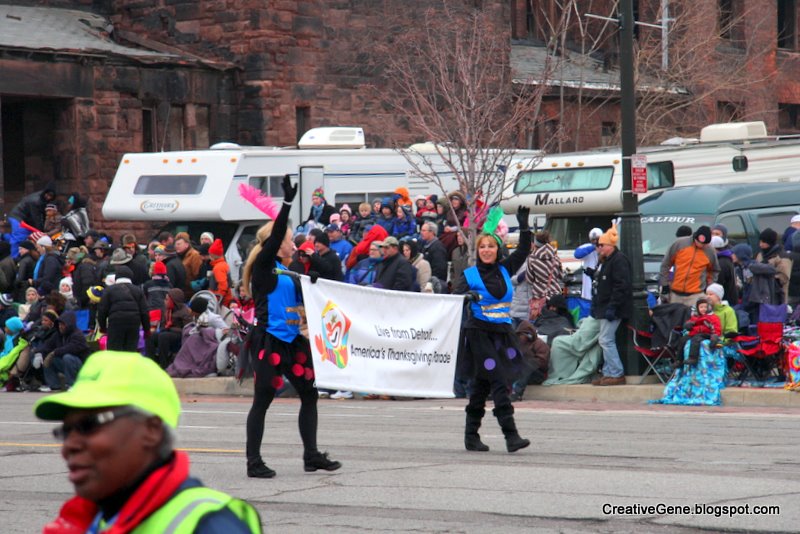 |
| The crowd cheered as the parade began. |
 |
| The first balloon this year was a new one, Kermit the Frog. |
 |
| Lots of clowns! |
 |
| Horses are always a crowd favorite. |
 |
| These uni-cyclists got lots of oohs and ahhs. |
 |
| Local marching band. |
 |
| More happy clown faces. |
 |
| It wouldn't be an all-American parade without Uncle Sam. |
 |
| New float this year, from Art Van Furniture. The biggest ever! |
 |
| Here he is, the jolly ole man himself! |
Sunday, September 18, 2011
Touched by An Angel, Hugged by A King
As the seasons change for us, once again I find myself in that transition stage. I'm thinking less about the beach and more about my genealogy. My photography goes year 'round but even with that I'm less inspired to take pictures when it's cold and gray outside. This summer was wonderful. I'm sorry for all the folks who had severe weather. For us it was a hot, dry summer... perfect for beach-going and I did plenty of that.
 The last couple weeks aided my transition into fall. I got several good beach days in, took lots of beach, boating, and sunset pictures, and toured the tall ships that came into port. The tall ships remind me of history and with that my genealogy comes to mind (not that I had any ancestors on the Nina or the Pinta ;-) . A special treat for me was having The King and his Angel visit for a couple days. They toured the tall ships with me making the event all the more fun.
I'm always envious of the genealogy bloggers who are able to attend the Southern California Genealogy Jamboree in June. It would be so fun to meet all the folks I follow online. But that's not likely to happen for me in the foreseeable future. California is a long way from Michigan. That's why it was such a treat to meet The King, Randy Seaver, and his lovely wife Angel Linda. I was thrilled that they would come up and see me and allow me to show them a little bit of Pure Michigan.
Those of you who have met Randy know what a kind soul he is. Gentleman, scholar, friend... Oh and genealogy expert and blogger extraordinaire too. He's quick to smile, has a twinkle in his eye, and is patient and caring. What a lucky lady Linda is to have him for her husband. Of course Randy is fortunate too. Linda is an angel. She's funny, very intelligent, outgoing, and very compassionate. She's a strong, independent woman who manages to find the good in everyone and everything. She is my role model. Now that I've met her I feel I've been touched by an angel.
One can't spend time with Randy without talking at least a bit about genealogy. We did that and I truly enjoyed it. It's so nice to spend time with a kindred soul. It got me thinking about my family history and how nice it will be to get back into my research and writing. Mother Nature's autumn color show will be here in just a few weeks and I'll be out there photographing all the lovely colors as much as I can. And then it will be time to focus on my genealogy and family history as the leaves fall from the trees once again.
OK summer, I guess I'm ready to let you go for this year. I'm looking forward to next year's beach weather already! But in the mean time, I'll be dusting off the genealogy books and getting back to writing. I've been inspired by The King and his Angel.
Tuesday, July 20, 2010
Michigan Genealogy Resources

You're sure to find some helpful information in Miriam's other helpful resources for Michigan too!
Michigan Online Historical Directories
Michigan Online Historical Newspapers
Let's hear it for Miriam! Hip, hip, hooray!
On behalf of all the genealogists researching in Michigan, THANKS MIRIAM!
Sunday, March 14, 2010
Michigan History for Genealogists

The 52nd annual Michigan in Perspective: the Local History Conference will be held March 19-20, 2010 at The Dearborn Inn. The conference was organized by the Michigan in Perspective Planning Committee and the lead sponsor and conference administrator is the Historical Society of Michigan. Other major sponsors include the Detroit Historical Society, Detroit Public Library and the Detroit Salt Company as well as the Detroit Society for Genealogical Research.There will be sessions on: Ethnic Detroit, Photojournalism Resources in Detroit, Women in Michigan History, Oral History, Genealogy, Historic Preservation, Michigan's Aviation and Maritime History, the Underground Railway in Detroit, and Revolutionary Detroit. Whew! Something for everyone!
Check out the brochure for more details.
PGSM Spring Meeting Schedule
The Polish Genealogical Society of Michigan has some great meetings lined up in the next few months...
On March 20, the PGSM will hold its first meeting of the year in the Panorama Room at the Orchard Lake Schools from 2:00-4:00 p.m. Polish Mission Director Marcin Chumiecki and Archives Director Rev. Stanislaw Flis will host an exhibit of campus genealogical holdings. Many documents and artifacts are exclusive to this institute.
On April 17, volunteers at the Bloomfield Family History Center will describe the materials available to all genealogical researchers. The centers provide free access to thousands of vital records from throughout the world, in addition to other resources.
April 28 to May 1, the PGSM will host the United Polish Genealogical sessions at the National Genealogical Seminar in Salt Lake City, Utah.
On May 15, the PGSM will visit the Bentley Historical Library at the University of Michigan. Archivist Malgosia Mys will present the Polish American Finding Aid.
On June 19, Mark Bowden of the Burton Collection at the Main Branch of the Detroit Public Library will review Polish records at the site.
For specific times and details check out the PGMS site.
Monday, December 14, 2009
Christmas Gift Ideas for Michigan Genealogists
For those with ties to Michigan, here are some books you might want to put on your Christmas list or buy for someone who loves Michigan history. Looks like some great reading for genealogists and family historians!
LANSING – The Library of Michigan has announced the list of the 2010 Michigan Notable Books – 20 books highlighting Michigan people, places, and events.
“This year’s selections prove that persevering through economic and personal hardship is nothing new for Michiganians, and that this enduring and independent spirit has a long, rich history in the Great Lakes State,” said state Superintendent of Public Instruction Mike Flanagan.
Short stories of despairing people moving toward salvation; a biography of the state’s first geologist, who discovered many of Michigan’s natural treasures; and a children’s book that tells the story of a slave family’s flight to freedom are among this year’s most notable Michigan books.
“This year’s Michigan Notable Books bring to life the Michigan experience through vivid storytelling that creates portraits of the people and places that make Michigan great,” said State Librarian Nancy Robertson. “Addressing Michigan’s natural beauty, its innovative leaders or the faith of its people, these books celebrate Michigan as a place and a people that even in the most trying of times find transformation. The Library of Michigan is delighted to honor these 20 books as the 2010 Michigan Notable Books.”
Each year the Michigan Notable Books (MNB) list features 20 books published in the previous calendar year that are about, or set in, Michigan or the Great Lakes region, or are written by a Michigan author. Selections include nonfiction and fiction books that appeal to a variety of audiences and cover a range of topics and issues close to the hearts of Michigan residents.
Michigan Notable Books is a statewide program that began as part of the 1991 Michigan Week celebration, geared to pay tribute and draw attention to the many people, places and things that make Michigan life unique. In that regard, MNB successfully highlights Michigan books and writers focusing on the Great Lakes State. Each title on the 2010 list gives readers insight into what it means to make your home in Michigan and proves some of the greatest stories are indeed found in the Great Lakes region.
This year’s Michigan Notable Book selection committee includes representatives from the Library of Michigan; Borders Inc.; Cooley Law School; The Detroit News; Detroit Public Library; Grand Valley State University; Lansing City Pulse; Michigan Center for the Book; Michigan Historical Center; Schuler Books & Music; and the Traverse City Record Eagle.
The Library of Michigan museum store will carry the 2010 Michigan Notable Books and the books will also be available at the Michigan e-store at http://apps.michigan.gov/MichiganeStore/public/Home.aspx. Many books are also available at Amazon.com
For more information about the MNB program, call 517 373-1300, visit www.michigan.gov/notablebooks or e-mail michigannotablebooks@michigan.gov.
The 2010 Michigan Notable Books are:
American Salvage: Stories by Bonnie Jo Campbell. Wayne State University Press.
In these stories about cold, lonely, working-class Michigan life, Campbell creates a world where salvation counterbalances loss and despair, and she leaves the reader with a sense of hope and belief things will get better. Campbell’s daring stories and exceptional writing create an image of rural Michigan that lingers and cannot be forgotten.
Annie’s Ghosts: A Journey into a Family’s Secret by Steve Luxenberg. Hyperion.
The fear of mental illness hits deep into the psyche, and that terror brings about this fascinating book of research into family genealogy, personal history and secrets long held. It all started when Detroit native Steve Luxenberg began to discover some discrepancies in his mother’s stories about her family as she neared the end of her life. A complex blend of genealogy research, cultural mores and a long-past Detroit are brought alive. Despite the secrets, Luxenberg’s love of his family is clear, and while not all is discovered, much is, and his story becomes a story that belongs to all of us.
The Art Student’s War: A Novel by Brad Leithauser. Alfred A. Knopf.
The vividly depicted city of Detroit takes a lead role in this historical coming-of-age novel set in World War II. A talented art student, Bianca Paradiso volunteers to draw portraits of wounded soldiers at the local hospital. As turmoil engulfs her Italian family, Bianca struggles in both her relationship with one of her sketch subjects and her budding romance with the son of a local drug store titan.
Bath Massacre: America’s First School Bombing by Arnie Bernstein. University of Michigan Press.
On May 18, 1927, an explosion rocked the small town of Bath, in Clinton County, when dynamite planted by Andrew Kehoe detonated in the basement of the local school. In this dramatic history of the horrific tragedy that claimed more than 40 lives (most of them schoolchildren), including Kehoe and his wife, the author skillfully explores the origins and events leading up to the tragedy, the terrible destruction at the school and Kehoe’s farm, and how the stunned community struggled to cope in the immediate aftermath.
Fordlandia: The Rise and Fall of Henry Ford’s Forgotten Jungle City by Greg Grandin. Metropolitan Books/Henry Holt.
The remarkable story of Henry Ford’s failed attempt to transform the rugged Brazilian Amazon rainforest into both a factory and a model American-style town, complete with golf courses and ice cream shops. Fordlandia represents a fascinating dichotomy matching the Amazon rainforest, with its complex natural environment and rugged conditions, against the automobile industrialist who had perfected the assembly line.
Have a Little Faith: A True Story of a Last Request by Mitch Albom. Hyperion.
Mitch Albom offers a story about his eight-year journey between two worlds, two men and two faiths. After Albom’s hometown rabbi asked him to deliver his eulogy, Albom tried to learn more about the man and found himself thrown back to a world of faith he’d left years ago. By examining his faith, Albom also connected with a Detroit pastor, a former convict preaching to the poor and homeless in a decaying church with a hole in its roof. Ten percent of the profits from this book will go to charity, including The Hole in the Roof Foundation, which helps refurbish places of worship that aid the homeless.
Isadore’s Secret: Sin, Murder and Confession in a Northern Michigan Town by Mardi Link. University of Michigan Press.
An astonishing story of a nun who was murdered in Isadore nearly 100 years ago. Years after the nun’s disappearance, her bones were found, but only when local law enforcement found out about this murder as gossip spread through the town was anything done to find out who killed the nun, Sister Janina. A compelling story and a well-researched and carefully written account of the events that affected Isadore and its Catholic Polish population so greatly.
January’s Sparrow by Patricia Polacco. Philomel.
In January 1874 in Marshall, slave takers came to take the Crosswhites back to Kentucky. This is the story of how the Crosswhites came to Marshall, why they stayed there and what happened on that day the whole town rose up to save the Crosswhites from the slave takers. This is Polacco’s second time on the Michigan Notable Books list (An Orange for Frankie).
The Lost Tiki Palaces of Detroit: Stories by Michael Zadoorian. Wayne State University Press.
Interesting and quirky characters abound in this engaging collection of short stories set in and around Detroit. Divided in sections appropriately named West Side, East Side and Downtown, the collection portrays common themes relevant to the region and the city, including hardship, racial tension and hope.
Michigan’s Columbus: The Life of Douglass Houghton by Steve Lehto. Momentum Books.
This well-researched and readable biography details the extraordinary – and tragically short – life of one of the most important figures in Michigan history. Having earlier accompanied Henry Rowe Schoolcraft on his expeditions through the Lake Superior region and the upper Mississippi valley, Houghton was the state’s first geologist, from 1837 until his death at age 36 in 1845. His 1841 annual report detailed the rich copper deposits found in the Keweenaw Peninsula, and, by suggesting they could be mined successfully and profitably, helped foster Michigan’s subsequent mining boom. This is Lehto’s second time on the Michigan Notable Books list (Death’s Door: The Truth Behind Michigan’s Largest Mass Murder).
Nothing But a Smile: A Novel by Steve Amick. Pantheon Books.
Steve Amick gives the reader a remarkable portrait of postwar America. When Wink Dutton is discharged from the army in 1944, he has little to his name besides his Purple Heart. His prospects change unexpectedly, however, when he meets the beautiful Sal Chesterton. The story plays out against wartime struggles, the Chicago underworld of the 1940s and 1950s, HUAC and the Red Scare and the postwar migration of Americans from the cities to the suburbs. This is Amick’s second time on the Michigan Notable Books list (The Lake, The River & the Other Lake).
Orlando M. Poe: Civil War General and Great Lakes Engineer by Paul Taylor. Kent State University Press.
A comprehensive biography of General Sherman’s right-hand man, Orlando M. Poe, who served in the Civil War, commanded the 2nd Michigan Infantry and led brigades at Second Bull Run and Fredericksburg. This influential man was much praised for his bravery and service. He went on to lead an illustrious career as the supervisor for the design and construction of numerous Great Lakes lighthouses and then designed and constructed the largest shipping lock in the world at Sault Ste. Marie.
Our People, Our Journey: The Little River Band of Ottawa Indians by James M. McClurken. Michigan State University Press.
Utilizing compelling photographs of the families that constitute it, this important and well-researched history of the Little River Band of Ottawa Indians traces the tribe’s migration into Michigan’s Grand River Valley, its later settlement on reservations in Mason, Muskegon and Oceana counties, the difficult relationship between the tribe and the U.S. government and successful efforts to maintain the tribe’s unique cultural identity through the present day.
Pandora’s Locks: The Opening of the Great Lakes-St. Lawrence Seaway by Jeff Alexander. Michigan State University Press.
A powerfully and thoughtfully written story of the impact the opening of the Great Lakes has had on the environment, water conditions and quality of life in the Great Lakes states. The high cost of tolerating dumping deep-sea ballast and exotic species into the lakes is carefully detailed and the personal cost is well displayed. This is a well-researched book that indeed gives one hope among the ruins. This is Alexander’s second time on the Michigan Notable Books list (The Muskegon: The Majesty and Tragedy of Michigan’s Rarest River).
Roses and Revolutions: The Selected Writings of Dudley Randall edited by Melba Joyce Boyd. Wayne State University Press.
This beautifully edited anthology pulls together Dudley Randall’s major works in one volume. Long-time Detroit resident Randall was the founder of Broadside Press, which published many well-known Black poets. He was one of the foremost voices in African-American literature during the 20th century and was very influential in his mentoring activities. The poems and the short stories show the changes in civil rights and historical events during his 80 years of life, and depict a man who had a deep love for people.
Season of Water and Ice by Donald Lystra, Switch Grass Books/Northern Illinois University.
Donald Lystra creates a touching coming-of-age story set in rural northern Michigan in 1957. Bookish loner Danny DeWitt befriends Amber Dwyer, a pregnant teenager who has been abandoned by her boyfriend and rejected by her family and community. Seasons of Water and Ice explores the themes of independence and obligation, courage and surrender, and love and sexuality. The book will appeal to both adult and young adult readers.
Stitches: A Memoir by David Small. W. W. Norton.
Socrates says that an unexamined life is a life not worth living. David Small’s heartbreaking story reveals a well-examined life, bringing to light a troubled family and its impact on him as a child, from living in an extremely quiet and depressing environment with angry undertones, to undergoing extremely traumatic throat surgery and waking up unable to speak. A remarkably illustrated story of a child who found refuge in books and in drawing, and, in the end, became his own man.
Travelin’ Man: On the Road and Behind the Scenes with Bob Seger by Tom Weschler. Wayne State University Press.
Following Bob Seger’s career from the late 1960s, through such highlights as Beautiful Loser, Live Bullet and Night Moves, and culminating in his 2004 induction in the Rock and Roll Hall of Fame, readers will eagerly turn the page in this behind-the-scenes photographic look at one of Michigan’s music icons.
Up the Rouge!: Paddling Detroit’s Hidden River by Joel Thurtell. Photographs by Patricia Beck. Wayne State University Press.
This is a beautifully photographed story of a journey up Detroit’s Rouge River to investigate whether cleanup efforts are paying off. Two Detroit Free Press journalists undertake a very difficult five-day trip up the river, which involved not just peacefully canoeing but also avoiding getting dunked in a very contaminated river and dragging their canoe over debris and rubbish tossed in the river. Photos show an astonishing number of boats simply abandoned in the river, along with random cars, washing machines and other detritus of civilization.
When March Went Mad: The Game That Transformed Basketball by Seth Davis. Times Books.
Thirty years ago, college basketball was not the sport we know today. Not many games were televised nationally, and the NCAA tournament was not the cultural phenomenon it is today. Two exceptional players, Earvin “Magic” Johnson and Larry Bird, almost single-handedly changed everything. Although they played each other only once, in the 1979 NCAA finals, that meeting launched an epic rivalry, transformed the NCAA tournament into the multibillion-dollar event it is today and laid the groundwork for the resurgence of the NBA. Seth Davis’ well-written book explores Bird and Johnson, the 1979 NCAA tournament, and the impact these great players had on the game.
Thursday, November 05, 2009
PBS Documentary on the Polar Bears of WWI
 A documentary on the Polar Bears of WWI will air this Sunday, November 8 at 3pm on Detroit's public television station. The "Polar Bears" were a group of Michigan WWI soldiers who fought against the Russians in frigid conditions near the arctic circle. The movie was filmed last January in Michigan's upper peninsula where frigid conditions resembled those experienced in Russia during WWI.
You can read more about the movie making and the actors involved in the project here. The documentary, Voices of a Never Ending Dawn, has it's own web site here.
Tuesday, September 22, 2009
Family History Month events at the Library of Michigan
Family History Month events at the Library of Michigan
Please join us in October as we celebrate Family History Month!
Free Family History Month workshops will be held in October at the Michigan Library and Historical Center in downtown Lansing. Each week, two sessions will be offered Tuesday morning, and these sessions will be repeated Wednesday afternoon.
To register, please go to http://www.facebook.com/l/72ff1;www.michigan.gov/familyhistory, e-mail librarian@michigan.gov or call (517) 373-1300. For more information about these events or to let friends know you'll be attending, please see the Facebook Michigan Genealogy group. The complete schedule of events is:
Tuesday, Oct. 6
10:15 a.m.: Beginning Your Genealogy Research
11:15 a.m.: Michigan Vital Records
Wednesday, Oct. 7
2:15 p.m.: Beginning Your Genealogy Research
3:15 p.m.: Michigan Vital Records
Tuesday, Oct. 13
10:15 a.m.: HeritageQuest
11:15 a.m.: Look @ Seeking Michigan
Wednesday, Oct. 14
2:15 p.m.: HeritageQuest
3:15 p.m.: Look @ Seeking Michigan
Tuesday, Oct. 20
10:15 a.m.: Ancestry Library Edition
11:15 a.m.: The Ultimate Civil War Resource
Wednesday, Oct. 21
2:15 p.m.: Ancestry Library Edition
3:15 p.m.: The Ultimate Civil War Resource
Tuesday, Oct. 27
10:15 a.m.: Michigan Roots: Research in the Wolverine State
11:15 a.m.: Genealogy of a House
Wednesday, Oct. 28
2:15 p.m.: Michigan Roots: Research in the Wolverine State
3:15 p.m.: Genealogy of a House
Thursday, August 20, 2009
Is Technology the Way Forward for the Library of Michigan?
What's to become of the Library of Michigan? I don't have the answer to that but like many people I am concerned about it. I wish the State of Michigan hadn't fallen on hard times. I wish our unemployment wasn't the highest in the nation. I wish our state budget had money to fund the Library of Michigan and all it's wonderful collections. But recent actions by our Governor suggest that we don't.
Reality is hard to swallow sometimes. Like now. But you know what they say, "trying times are for trying". I'm thinking it's time for us to be trying something new. Even as I write this I am anticipating the groans from people who don't want to go beyond their comfort zones when it comes to technology. But groan if you will, I'm going to suggest that it's time to digitize he holdings of the Library of Michigan.
Google is in the process of digitizing the entire library system of the University of Michigan (et al) which is much larger than the Library of Michigan. They have the equipment and the know-how to scan massive quantities of printed books. Michigan should be the first state to have it's library holdings digitized, out of necessity, and Google is the perfect partner to take on the digitization of the printed books portion of the library's holdings. In the genealogy collection, many of the books are out of print and their copyright has run out. Having those items available online would be adding to the goldmine that already exists in GoogleBooks. Yes, many of the Library of Michigan's books would still be inaccessible due to copyright protection. But isn't it worth considering the idea for the many books that would be accessible?
And what of the all the reels of microfilm at the Library of Michigan? I would propose that Heritage Quest is in the perfect position to deal with those. I believe they already have the equipment to scan films and put them online and they already have an agreement with the State of Michigan (Michigan residents already get free access to Heritage Quest). What about the cost involved in indexing the microfilms? Don't do it. Don't index the microfilms any more than they already are. There's no database index of the microfilms now so it wouldn't be any different than if you were on site doing research. Heritage Quest would still have some costs involved but they could recoup the cost with the increase in subscribers from out of state who would love to have access to all of the Library of Michigan's microfilm holdings.
Is this plan a "no brainer"? No. Of course not. There are legal issues and financial issues to be taken into account. But if the idea were given serious consideration and all interested parties could sit down at a table together I'll bet they could come to some sort of agreement that would allow this to happen. The residents of Michigan would be the big winners here. Let's face it, it would be awfully convenient to have online access to the Library of Michigan's holdings.
It's likely that the Library funding will be cut and the holdings could well be dispersed. But if we could get some sort of agreement in place in short order, perhaps the funding could be found to keep the library open until it's holdings have been digitized. Like it or not, we may not be able to continue doing business (and our hobby) the way we've always done it here in Michigan. I think the time has come to take a digital step forward and let current technology help us out here.
What do you think?
Monday, July 27, 2009
Sad Days for the Library of Michigan
Let me start off by saying that it breaks my heart to think of the wonderful genealogy collections at the Library of Michigan being broken up into parts and sold or distributed to other institutions. It has taken many years and lots of tax payers' dollars (not to mention the tremendous efforts of dedicated employees and volunteers) to amass this collection that we genealogists in Michigan value tremendously and are darn proud of.
The library building is wonderful, the holdings are wonderful, and the staff is wonderful.
Where would we genealogists be without it all? I haven't a clue.
Having said that, our state is in the position of having to make drastic budget cuts to essential services. Reality check time. We just don't have the money to support non-essential services in the way we have in the past. I've been asking myself for some time now how we can continue to operate the state supported cultural programs while we eliminate Michigan State Police officers and close posts.
It's easy to wink and say we could do with one less State Police officer when we see them in the median of the interstate with their radar guns in action. But if you've ever been stranded on an icy freeway or caught in a 20-car pileup, you know what essential services they provide. And the state crime lab is waaay behind on their cases, especially since the crime lab in Detroit was shut down. And what about budget cuts for state prisons? Does anyone think we should shut more down and have more felons on the streets? Not me.
Please don't brand me as a traitor here. What I said in the beginning is truly what I feel. But I also know that we can't keep doing business as usual here in Michigan. We simply can't afford it. Personally, my safety is a higher concern for me than my hobby. But that doesn't mean I'm willing to turn my back on my hobby altogether.
There is a group of concerned genealogists here in Michigan who is planning an assembly on the steps of the State Capitol followed by a walk to the Library of Michigan where they will hold hands encircling the library in a show of support. The date is August 5th, 2009, time 9:45am. I urge you to be there to show your concern for the Library of Michigan. I'm going to try my best to be there to show my support.
I seriously doubt if the Library as we know it with all it's wonderful collections can be spared the chopping block given the current economic situation here in Michigan. And I don't necessarily think it should. But it is my most fervent hope that those in a position to determine the outcome of this situation can find a way to keep the collections together as they are now. I don't know what kinds of options there might be for this to occur but I sincerely hope they are seriously considered and prioritized. I also think it is essential that the collections continue to be made available to the public for free as they are now. That makes the task all the more difficult. But, we have some very intelligent and talented individuals working on this at the state level and I'm sure they'd like to feel some support from their constituents. I say we show them that we care about the resources in our library and we don't want them to be redistributed.
If you can't be at the Capitol on August 5th, please show your concern and support by contacting Michigan legislators. You can find the House Reps here and the Senators here.
For more details about the August 5th assembly, see the Michigan Genealogical Council web site.
Please try to get the word out to as many people as you can. Thank you!
Wednesday, July 08, 2009
Free Genealogy Presentations Right in My Own Backyard!
Your Ancestors in Volhynia and Poland, 1700-1900:
How They Got There and How They Lived
Monday, July 13th, 7:00pm
Join us on Monday, July 13th, for a discussion on Polish ancestry presented by William Remus: Volhynian descendant, graduate of the SJHS Class of 1962, and University of Hawaii Professor Emeritus. Maud Preston Palenske Memorial Library, St. Joseph, MI (Thanks Apple!)
Berrien County Genealogical Society:
July 15, 2009 ~ Wednesday ~ “How to Organize Your Family Data”
Time: 7:00 p.m. at the Berrien Springs Community Library 215 W. Union St.
I was going to return to Detroit this weekend but since these interesting sessions will be offered here next week I just may have to stay another week!
Tuesday, July 07, 2009
Abrams Genealogy Seminar at the Library of Michigan
The Library of Michigan is pleased to announce that the 2009 Abrams Genealogy Seminar will take place on Friday and Saturday, July 17-18 at the Michigan Library & Historical Center in Lansing.
This fourth annual Library of Michigan signature event represents a unique opportunity for researchers to spend two full days at the Library utilizing our vast array of genealogy resources and learning about specific topics of interest including cemetery research, Michigan death records, online research for the British Isles, New England area research and much more.
A highlight of the seminar will be a keynote address, co-sponsored by the Eaton County Genealogical Society, featuring Stephen Morse, famous for his outstanding One-Step Webpages at stephenmorse.org. These online tools are an invaluable resource for genealogists for topics as diverse as Ellis Island ship lists, U.S., Canadian, and British census records, and even calendar conversions and language translation.
As in previous years, the Abrams Seminar will include a library and archives research track, in which facilities with extensive genealogical and historical holdings will outline their collections. Participating libraries and archives include the Library of Michigan, the Archives of Michigan, the Burton Historical Collection at Detroit Public Library, the Capital Area District Library in Lansing and the Allen County (Ind.) Public Library.
The schedule for the seminar is as follows:
Friday, July 17- 12:30 - 1 p.m.
- A. Archives of Michigan Tour
- 1:15 - 1:45 p.m.
- B. Library of Michigan Tour
- 2 - 3 p.m.
- D. Researching Your Female Ancestors
- - Edwina Morgan, Library of Michigan
- E. Michigan Biographical Index
- - James N. Jackson, Professional Researcher
- F. Genealogical Research at the Library of Michigan
- - Randy Riley, Library of Michigan
- 3:15 - 4:15 p.m.
- F. Cemetery Records: Dying to Get in There!
- - Karen Krugman, Professional Researcher
- G. The Ultimate Michigan Civil War Resource
- - Mark Harvey, Archives of Michigan
- H. Resources from the Forest Parke Library & Archives Collection
- - David Votta, Capital Area District Library, Lansing
- 9:30 - 11:30 a.m.
- I. Welcome & keynote address: One-Step Webpages: A Potpourri of Genealogical Search Tools
- - Stephen Morse
- 11:30 a.m. - noon
- J. Presentation of the Carole Callard Genealogy Appreciation Award
- Noon - 1 p.m.
- Lunch
- 1 - 2 p.m.
- K. One-Step Webpages: A Hodgepodge of Lesser-Known Gems
- - Stephen Morse
- 2:15 - 3:15 p.m.
- L. Casting the "Net" Over Your British Isles Ancestors
- - Richard M. Doherty, Professional Researcher
- M. Genealogy 2.0: Social Networking and Family History
- - Gloriane Peck, Library of Michigan
- N. Treasures for Researchers at the Genealogy Center in Fort Wayne
- - Curt Witcher, Allen County Public Library
- 3:30 - 4:30 p.m.
- O. Researching Your New England Ancestors
- - Charles Hagler, Library of Michigan
- P. Seeking Michigan Death Records? A New Digitization Project
- - Kris Rzepczynski, Library of Michigan
- Q. Research at the Burton Historical Collection at the Detroit Public Library
- - Mark Bowden, Detroit Public Library
Additional information and the registration form are online. Questions? Please contact the Library at (517) 373-1300 or librarian@michigan.gov.
New Hours at the Library of Michigan
New Public Hours at the Library of Michigan
The Library of Michigan's has new hours of operation starting Tuesday, July 7. The change of hours provides a more consistent schedule of hours of operation than the library was previously open. The changes will also help the facility to control overall costs.
Library hours will be:
- Main Library 10 a.m. - 5 p.m., Monday through Saturday
- Law Library: 1 p.m. - 5 p.m., Monday through Friday
- Rare Book Room: 1 p.m. - 5 p.m. Monday through Friday (other hours by appointment)
- Services for the Blind and Physically Handicapped: 10 a.m. - 4 p.m., Monday through Friday.
Thursday, May 28, 2009
Updates on St. Joseph/Silver Beach
As a follow-up to my article about the history of St. Joseph, Michigan, I'd like to share with you some photos showing the projects at Silver Beach that are underway.
First, this is the new Shadowland Ballroom being built.

And this is the new "antique" Silver Beach Carousel under construction.

And lastly, this is the new Compass Rose Fountain in the works.

It isn't exactly a reincarnation of the Silver Beach of days past but I'm sure many will enjoy all that the new Silver Beach will have to offer when it opens later this year or early next year. I'm ready for the fun!
Wednesday, October 08, 2008
The Great Michigan Fire of October 8, 1871
The Chicago Fire of 1871 gets (justifiably) a great deal of attention. Something that is not as well known is the fact that it was only one of a number of major fires across the Midwest that burned millions of acres and caused over 1200 deaths. The worst of these destroyed the city of Peshtigo, Wisconsin which killed over 800 people. Michigan was dealt grievous blows from "The Fiery Fiend" as fires swept across the state, wiping out or endangering entire cities, towns and villages including Holland, Manistee, Grand Rapids, South Haven and Port Huron doing millions of dollars worth of property damage and killing hundreds. [More]I came across this on the Michigan in Pictures blog today and
 I thought it might be of interest to folks who had family in Michigan back in 1871. That was a bit before my earliest ancestors got here in 1881 so they wouldn't have experienced the horrific fire.
If you'd like to read more about this and another great Michigan fire (1881), you can do so on the following web sites:
Absolute Michigan
Wikipedia
University of Michigan News Service
Library of Congress, American Memory
Michigan DNR
Sunday, September 28, 2008
Livonia (MI) Celebrates Family History Month

The Livonia Public Library is offering a couple of presentations on historical times/events that may be of interest to genealogists.
A NIGHT TO REMEMBER: The Civic Center Library welcomes Craig Mestach, a member of the Titanic Historical Society, on Monday October 6th at 7:00 pm. Mr. Mestach will present "Titanic: The Ship, Voyage and Legend". For more information, call the Civic Center Library at (734) 466-2197.And also from the folks at the Livonia Library:
DETROIT'S NEFARIOUS PAST: The Friends of the Livonia Library welcome Paul R. Kavieff to the Civic Center Library Auditorium on Sunday October 19th at 2:00 pm to discuss "The Purple Gang", the ruthless and infamous Prohibition era organized crime gang from Detroit. Mr. Kavieff has authored four books on the history of organized crime in Detroit, including the recently published "Detroit's Infamous Purple Gang" and copies of this book will be available for purchase after the presentation. Refreshments will be served in the Michigan Room after the program. For more information, please contact the Civic Center Browsing Desk at (734) 466-2197
DATABASE OF THE MONTH OCTOBER 2008: The Livonia Public Library, the Library Network and the Library of Michigan continue to offer more databases and information for you to access from the internet in the library and at home! Each month, this newsletter will explore one or more of these databases and give an idea of what's available! October is Family History Month, and there are some databases available to you to help you in your genealogical research. Heritage Quest is accessible from your home computer. Heritage Quest has some U.S. Census records, books, periodicals, and revolutionary war era records, all searchable by name. Ancestry.com's Library Edition can only be entered from a computer at your local library, but it is an extensive resource including census information, vital records and public directories from the United States and other countries, drawn from the Ancestry.com website. This is not complete access to that website, but it is a wealth of information and a good starting place for your family tree search. (Also visit our web site at http://livonia.lib.mi.us/genealogy for some of the resources available at the Livonia Library and some links to other helpful websites.) To access the Heritage Quest database and others from home, you will need your library card, but accessing them from any Livonia Library is as easy as walking up to any catalog station! To take a look at the genealogical databases or any of the other databases available, visit the Livonia Library web site at http://www.livonia.lib.mi.us/mags.html.
IT'S FAMILY HISTORY MONTH GET STARTED DIGGING UP YOUR ROOTS: Doing genealogical research? The Livonia Public Libraries offer access to the database "Ancestry/Library Edition", a library version of Ancestry.com available at your local branch. This database covers census records, available birth, death, marriage and immigration information, books and periodicals and much more. If you'd like some help learning how to access this information and use this database effectively, the Civic Center Library will be offering one-on-one assistance on occasional Saturdays. In September, help will be available on Saturday October 4th. Registration for these sessions is preferred, and you can register at the Adult Reference Desk or by calling (734) 466-2490. For more information on these training sessions, please contact Carl Katafiasz, Head of Adult Services, at (734) 466-2480.
Saturday, September 27, 2008
Michigan Daily Obituaries
 I came across a new blog that is listing obituaries from Michigan. It's called Michigan Daily Obituaries but I don't think the obits are from the Michigan Daily newspaper of Ann Arbor. They seem to be from all over the state. Anyway, if you're interested in the Michigan Daily Obituaries blog check it out here.
Library of Michigan Celebrates Family History Month
 October means Family History Month in Michigan. And in that spirit the Library of Michigan will once again be offering a series of genealogy workshops at the Michigan Library and Historical Center, 702 W. Kalamazoo St. in Lansing. These workshops are held Tuesday mornings and Wednesday afternoons throughout the month. You can see a list of the workshops being offered and register online. The workshops are all free but you do need to register.
Subscribe to:
Posts (Atom)